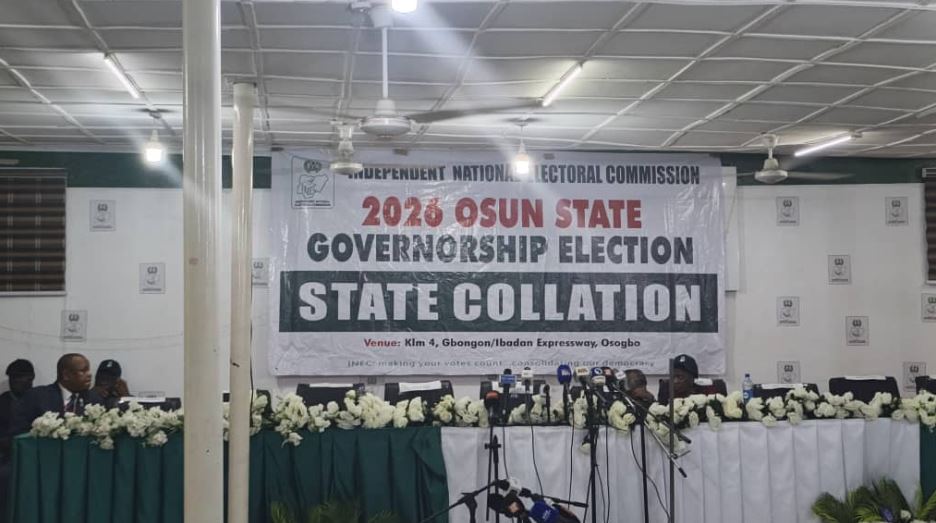
The most revealing pattern I saw around the 2026 Osun governorship election was that election misinformation is no longer simply about inventing stories. It is about manufacturing uncertainty: taking something real and giving it a false context, taking something old and making it appear new, presenting a faction as an entire political party, producing unofficial results before counting has been completed, and, increasingly, using artificial intelligence to make fabricated political content look believable.
That is the pattern that emerged before, during and after the August 15 election. And it suggests that Nigeria’s next electoral information challenge will not simply be how to detect AI-generated content. It will be how to defend the meaning of evidence itself.
FactCheckAfrica’s work around Osun provides a useful record of this transition. The TruthGuard Situation Room was deliberately built as a collaborative operation, bringing together FactCheckAfrica’s information-integrity work with BallotEyes observers and partners. On the ground, 75 polling-unit observers covered all 30 LGAs, supported by 30 stationary LGA observers and three roving observers. Online, the operation monitored misinformation, disinformation, manipulated media, suspected AI-generated content and coordinated attacks, while citizens could submit suspicious claims through WhatsApp.
Before the election: the information war started long before voting
What struck me before election day was how much of the misinformation environment was built around anticipation. The objective was not necessarily to convince voters of one elaborate lie. It was often to create a particular expectation about what was coming.
FactCheckAfrica’s pre-election analysis documented claims about candidate selection, endorsements, rigging, violence, polling locations, BVAS, security and other issues. The analysis of Osun’s information landscape found that misinformation increasingly operated through context manipulation rather than crude fabrication: an authentic photograph attached to a false claim, old footage presented as current, a genuine statement stripped of context or an official-looking document that did not originate from the institution it claimed to represent.
That distinction matters because it changes the fact-checker’s job. It is no longer enough to ask, Is this picture fake? The more important questions become: When was this picture taken? Where? What was happening? Who published it first? What does it actually prove?
One of the clearest examples was the claim that APC chieftain Akin Ogunbiyi had endorsed Governor Ademola Adeleke. The photograph was genuine. Reverse-image searching established that it came from the 2022 Osun election. The falsehood was therefore not in the pixels; it was in the context attached to them.
The Accord Party controversy revealed another layer. A real declaration supporting the APC candidate came from a faction associated with Christopher Imumolen. But it was presented online as though the entire Accord Party had changed its position. FactCheckAfrica rated the claim misleading after checking the competing party positions and official records.
This was an important warning about the kind of election misinformation we should expect going forward. Political manipulation does not always require fabricating an event. Sometimes it requires taking a true event and enlarging its meaning.
The same pattern appeared around the Arise TV town hall. A graphic circulated on WhatsApp claiming to show the candidates’ scores after the programme.FactCheckAfrica found no evidence that Arise News or the event’s partners had produced it. More tellingly, the graphic excluded other candidates who participated.
This is where AI changes the equation. The technology lowers the cost of producing convincing political material, but the deeper danger is that it accelerates an information culture in which appearance itself becomes evidence. A realistic screenshot, a convincing voice note, a photograph with the right faces or a professionally designed statement can acquire credibility simply because it looks official.
Election day: the battle shifted from persuasion to confusion
On election day, the information environment became even more difficult because speed itself became part of the problem. Claims about what was happening at polling units, who was leading and whether particular incidents had occurred were circulating while voting was still underway. In one of the clear examples, a viral claim said Ademola Adeleke was already leading in 13 local government areas.
Another graphic circulated with specific figures showing APC candidate Bola Oyebamiji ahead. Both claims appeared before voting and collation had been concluded, when no official result could yet establish either candidate as the leader. FactCheckAfrica therefore rated the Adeleke claim false at the time it circulated, not because an eventual result could never show such a lead, but because the claim presented an unofficial picture as an established election result while the process was still unfolding.
That timing matters. Election misinformation can influence an election before a false claim is ever formally proven or disproven. A premature declaration of victory can create expectations among supporters, shape how subsequent developments are interpreted and make later official results appear suspicious if they do not match what people have already seen online. The problem, therefore, is not only whether a number is eventually correct; it is whether the number is being presented as evidence at a point when the underlying electoral process has not produced that evidence.
A similar dynamic emerged around an incident in Modakeke, where a video began circulating during the voting period alongside claims of security intervention, tear-gassing and the alleged removal of a ballot box. The incident quickly became part of the wider conversation about whether voting was being disrupted in parts of Osun. Governor Ademola Adeleke also referred publicly to reports from Modakeke and alleged that voters were being driven away by tear gas and that a ballot box had been taken. Those allegations were still unverified when they were being discussed publicly.
The Modakeke case is particularly useful because it shows why election verification cannot stop at asking whether a video is real. FactCheckAfrica subjected the footage to digital keyframe analysis and established that the video itself was genuine and connected to the election. The police also confirmed that a tear-gas incident had occurred. But that did not establish every claim being made alongside the video. The specific allegation that a ballot box had been snatched could not be independently verified at the time of publication. The appropriate verdict was therefore partly true.
This distinction is easy to lose in a fast-moving information environment. A genuine video can authenticate an incident without authenticating the entire story attached to it. In Modakeke, there was evidence that something had happened; there was not enough evidence, at that point, to establish everything people were saying had happened. That is precisely why the circulation of the claim should be separated from the evidence eventually available to support it.
The same principle applied to the alleged voter-importation incident involving Accord lawmaker Abiola Ibrahim. FactCheckAfrica confirmed that the police had arrested him in connection with alleged voter mobilisation, but the specific claim that 146 people had been imported and that he had confessed could not be independently verified at the time.
Not every false or misleading election claim is AI-generated, and there is no need to attribute the Modakeke video, the premature result claims or other unverified allegations to artificial intelligence where the evidence does not establish that. The deeper lesson is broader: digital tools, social platforms and rapid sharing can make genuine material, incomplete information and unsupported claims travel together at extraordinary speed. AI is an important part of that changing information environment, particularly where synthetic images, audio or video are actually involved, but it should not become a catch-all explanation for misinformation that can be explained by older forms of manipulation such as premature reporting, misleading captions, selective framing or the amplification of unverified claims.
This is why the human verification layer remained so important. In the Situation Room, the response did not depend only on an AI detector deciding whether a piece of content was fake. Verification involved reverse-image searches, digital keyframe analysis, comparison with older material, official records and direct contact with authoritative sources. The response to new technology, therefore, was not more AI alone. It was evidence.
After the election: misinformation became a fight over legitimacy
The most interesting pattern, however, emerged after voting. Once INEC declared Adeleke the winner, the misinformation did not disappear. It changed form. Before the election, the central question was often: Who is winning? After the election, it became: Can we trust the result?
FactCheckAfrica documented a claim that the returning officer, Professor Joshua Ogunwole, had been arrested and detained in Abuja after declaring Adeleke the winner. The claim appears to have conflated two facts: that he travelled to Abuja and that someone alleged he had been arrested. FactCheckAfrica found no credible evidence of detention and cited his university’s confirmation that he remained free and at work.
Then came the viral image of APC governors supposedly holding an emergency meeting because of the party’s defeat in Osun. The photograph was real, but it was from a July meeting in Kebbi, not a post-election emergency meeting. Again, the image was not fabricated; its meaning was.
Also, the appetite for turning individual polling-unit results into broader political narratives appeared after the election. Social media users circulated claims about prominent political figures supposedly losing their own polling units, presenting such results as evidence of wider rejection.
One claim said former Osun Governor Olagunsoye Oyinlola had lost his polling unit; FactCheckAfrica verified that claim as true, with Accord recording 125 votes to APC’s 85 at his polling unit in Okuku. But another claim said former Governor Bisi Akande had been defeated at his polling unit, and that was false: the INEC result reviewed by FactCheckAfrica showed APC winning there with 181 votes against Accord’s 121.
The contrast is instructive. Polling-unit results are real pieces of electoral evidence, but their political meaning can quickly become distorted when individual outcomes are turned into sweeping claims about who has been rejected by voters or what the wider election supposedly means.
A related case involving Osun businesswoman and political figure Alhaja Falilat Yusuf, popularly known as Ero-Arike, showed how election misinformation can acquire a distinctly gendered dimension. A viral claim circulated figures purporting to show Accord defeating APC at her identified polling location, with some versions claiming 241 votes for Accord against 138 for APC.
FactCheckAfrica found those figures did not match the verified result: APC recorded 392 votes while Accord had 54. More importantly, the false figures became a vehicle for personal ridicule, with some of the online attacks directed at Ero-Arike not simply as a political actor but through sexist and humiliating language targeting her as a woman. This matters because the misinformation was doing more than misrepresenting a polling-unit result. It was attaching a supposedly electoral fact to a narrative about a woman’s political standing and using that narrative to legitimise personal attacks.
And then we saw the clearest post-election example of AI being weaponised: a fabricated image showing Adeleke apparently presenting his certificate of return to Peter Obi. FactCheckAfrica identified the image as AI-generated and found no evidence that Adeleke had presented the certificate to Obi. What was real was that Obi congratulated Adeleke after the election. What was fabricated was the photograph and the story attached to it.
This is where the post-election pattern becomes particularly worrying. AI can manufacture not only false events, but false political relationships: who met whom, who endorsed whom, who helped whom win, who celebrated with whom.
That matters because politics is heavily influenced by symbolism. A photograph can become political evidence even when it proves nothing.
There was another revealing post-election example: a supposed ₦15,000 cash transfer from Adeleke to celebrate his victory. The claim was not simply false; the link was designed to collect personal information and encourage users to forward it to WhatsApp groups. FactCheckAfrica found that the domain had been registered only days before the election and described the sharing mechanism as a phishing tactic. So the information war is also becoming an economic and cyber-security problem.
The real weapon may be doubt
The lesson to take from Osun is that AI’s greatest electoral power may not be the ability to make people believe something completely false. It may be its ability to make people doubt something that is true.
This is the emerging liar’s dividend. Once citizens know that politicians can be deepfaked, a politician can potentially dismiss genuine evidence as AI-generated. A real recording can be called fake. A genuine photograph can be described as manipulated. A legitimate result can be labelled fabricated.
That creates a dangerous information environment where the question is no longer simply, What is true? It becomes, Can we agree on what counts as evidence?
In an earlier interview, I captured this shift: AI is making the old assumption that “seeing is believing” increasingly unreliable. Verification now requires asking where material came from, who produced it, when it was produced, what it proves and what evidence corroborates it.
This is also why WhatsApp deserves much more attention. The most consequential piece of misinformation may not be the post that trends publicly on X. It may be a voice note forwarded through a ward, church, mosque, family, community or political WhatsApp group. FactCheckAfrica’s own assessment recognised that comprehensive visibility into closed environments such as WhatsApp remained a major operational gap.
What Osun tells us about 2027
Osun should therefore be treated as a warning ahead of Nigeria’s 2027 elections. The information battle is becoming faster, more personalised and harder to monitor. But the answer cannot simply be to build better AI detectors. Detection will always be chasing production.
The more sustainable response is to strengthen the entire information ecosystem: local journalists who understand verification, election observers who can provide ground truth, institutions that communicate quickly, fact-checkers with forensic capacity, platforms that respond to coordinated manipulation and citizens who understand that a viral post is a claim, not evidence.
The TruthGuard model demonstrated the value of connecting these layers. Field observers could provide context for what was happening physically, while fact-checkers tested what was being claimed online. Citizens could also feed suspicious material directly into the verification process.
But there is a limit to what fact-checking can do after a lie has already travelled. The correction has to reach the same networks that carried the falsehood. During Osun, FactCheckAfrica converted checks into short graphics and used a network of more than 70 trained journalists to distribute verified information beyond its own platforms. That may ultimately be the most important lesson.
The future of election integrity will not be secured by fact-checkers alone. It will depend on whether Nigeria can build a culture in which citizens pause before forwarding, journalists verify before amplifying, political actors resist weaponising falsehood, institutions respond quickly and technology companies recognise that information manipulation is part of electoral infrastructure.
Osun showed us something else: misinformation does not have to change every vote to damage democracy. It can work by creating fear before people vote, confusion while they vote and doubt after the votes have been counted. And that may be the most sophisticated form of AI-enabled political manipulation yet!