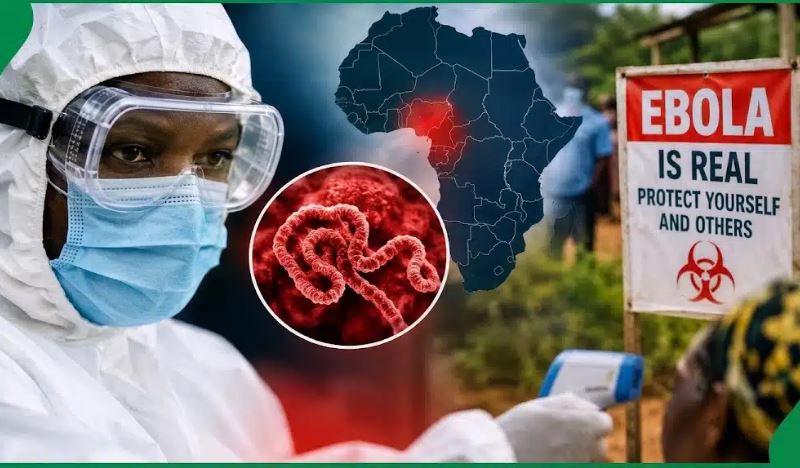
Nigeria’s preparedness to tackle major disease outbreaks has come under fresh scrutiny following the confirmation of an Ebola case in the country, more than 12 years after it successfully contained its first recorded outbreak.
The Federal Government, through the Federal Ministry of Health and Social Welfare, confirmed the case on October 20, 2026, after laboratory tests detected the Ebola virus in a woman who had recently travelled to Nigeria from Uganda, Naija News reports.
The patient was admitted to a private hospital in the Federal Capital Territory (FCT), Abuja, where she received treatment before the infection was confirmed.
According to the government, she was subsequently placed in isolation and receiving medical care.
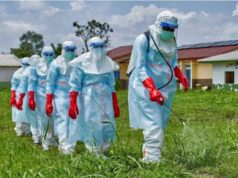
The development came amid a wider Ebola outbreak affecting parts of Africa, raising concerns about the ability of countries to detect infections early, protect healthcare workers and prevent further transmission across borders.
Following the confirmation, health authorities began contact tracing, identifying 44 people who had been in close contact with the patient.
The government also intensified disease surveillance and strengthened infection prevention measures at the hospital, while directing public and private health facilities across the country to remain alert for suspected cases.
Although the confirmation has raised concerns among Nigerians, the World Health Organization (WHO) has cautioned that one imported case does not, by itself, mean the country is experiencing an outbreak.
The organisation has urged the public to remain calm, avoid misinformation and follow guidance from health authorities as investigations and contact tracing continue.
However, the situation has renewed questions about whether Nigeria and other African countries have learnt enough from previous Ebola outbreaks and the COVID-19 pandemic, particularly in the areas of early detection, emergency funding, laboratory capacity and community awareness.
Against this backdrop, a Senior Registered Community Health Practitioner (RCHP) in Oyo State, Samson Ojo, has assessed Africa’s level of preparedness for another major pandemic, highlighting existing weaknesses and the urgent steps governments need to take to strengthen their response systems.
‘African Countries Still Poorly Prepared’
Ojo acknowledged that African countries have made some progress in preparing for disease outbreaks, but poor funding, weak disease surveillance and a shortage of trained health workers continue to threaten their ability to respond to another major pandemic.
According to him, the continent was better prepared than it was in 2014, but many countries still lacked the resources and systems needed to detect and contain outbreaks early.
Ojo, who spoke with a Naija News correspondent on Africa’s preparedness amid the recurring threat of Ebola, said some countries had established disease control agencies, laboratories and emergency operation centers following previous outbreaks.
However, he noted that preparedness remained weak at the primary healthcare level, where many communities first seek medical attention.
“African Countries are not doing very well yet, however they are much better than 2014,” he said.
He explained that some African countries had established disease control agencies, laboratories and emergency operation centres following previous outbreaks.
However, he noted that preparedness remained weak in many primary healthcare facilities in Nigeria.
“In Nigeria funding is low, there is no surveillance and many facilities lack PPE, isolation wards, and trained and qualified staff,” Ojo said.
‘Why Africa Remains Vulnerable’
Speaking on Thursday during an interview on Channels Television’s The Morning Brief, the Director-General of the Africa Centres for Disease Control and Prevention (Africa CDC), Dr Jean Kaseya, accused international partners of neglecting Africa in the search for a vaccine against the Bundibugyo strain of Ebola.
Kaseya said an approved vaccine could have been made available if the outbreak had affected Western countries.
He blamed the lack of international interest for the delay in developing one and called on African countries to invest more in vaccine research and production.
“I can tell you, if this outbreak was in Western countries, vaccine will already be available. Why this vaccine today is not available? Because some of our partners decided to consider this issue as an African issue, they were not interested,” Kaseya said.
However, Ojo identified poor funding as one of the biggest challenges facing Africa’s outbreak response systems.
According to him, many countries depend on donors and foreign partners to finance emergency responses, making it difficult to sustain preparedness when external support is unavailable.
He also pointed to weak community surveillance, limited laboratory capacity, a shortage of health workers and outdated reporting systems as factors that could delay the detection and control of outbreaks.
“Underfunded health care systems’ outbreak budget for outbreak response often depends on donors and foreign partners. There is weak to no surveillance at the community level, which makes cases hide for days,” he said.
Ojo added that many health facilities lacked the capacity to test suspected cases quickly, forcing some samples to travel long distances before confirmation.
He further noted that the continued use of paper records in many places slowed down the sharing of information and the speed of response.
“Most samples will have to travel far for confirmation. There is Health workforce shortage and work overload on the available staff,” he said.
On the use of technology, he said, “African countries are yet to adopt modern computing document systems which aid reporting and response. They are still stuck with paper records which slow down response.”
‘Late Detection Could Worsen Outbreaks’
Ojo said African countries were not always able to detect suspected cases early enough to prevent wider transmission.
He explained that while urban areas might have better access to health services, rural and border communities often faced delays because of poor access to healthcare, traditional healing beliefs and fear of reporting suspected cases.
“Early detection is not always in African nations. In urban centers, detection is faster, but in rural and border communities, where outbreaks often start, detection is always late due to poor access, traditional healing beliefs, and fear of reporting,” he said.
He warned that by the time an infected person reached a higher-level health facility, the disease might already have spread to other people.
The RCHP officer also raised concerns about cooperation among African countries during disease outbreaks, describing it as weak despite existing regional agreements.
He said porous borders and slow information sharing could make it difficult for neighbouring countries to coordinate their responses.
“Realistically, cooperation is shallow and weak. Africa’s borders are porous, information sharing is slow, and countries often close borders unilaterally without coordination, which drives secret crossings and hides cases. Joint simulation exercises are still shallow,” he said.
However, he acknowledged that regional frameworks were already in place to guide cooperation.
“However, on paper, ECOWAS and Africa CDC protocols exist,” he, a health practitioner, noted.
‘Lessons From COVID-19 and Previous Ebola Outbreaks’
Ojo said African governments had yet to fully address some of the weaknesses exposed by COVID-19 and earlier Ebola outbreaks.
He identified limited local production of vaccines and diagnostic tools, weak community engagement and inadequate long-term funding for infection prevention as some of the outstanding challenges.
He also expressed concern that some measures introduced during the COVID-19 pandemic had not been sustained.
“There is still no Sustained funding for infection prevention. After COVID, many handwashing stations and IPC training were abandoned,” he said.
The health officer further noted that shortages of health workers remained a major concern, adding that many trained personnel had left the health sector.
On Nigeria’s preparedness, Ojo further said the country was better equipped to respond to an Ebola outbreak than it had been in previous years, but warned that significant weaknesses remained at the state level.
He said the Nigeria Centre for Disease Control and Prevention (NCDC) had strengthened its systems, while laboratories in several states and health screening at ports had improved the country’s response capacity.
“While some Africa Countries are not very well prepared. Nigeria is better prepared than the previous years when we contained it through quick action,” he said.
However, he warned that many general hospitals lacked functional isolation facilities and that public compliance with infection prevention and control measures had declined compared with previous outbreaks.
He said these gaps could weaken Nigeria’s response if an Ebola case were detected.
‘How Governments Can Build Public Trust’
Ojo said effective communication would be important in preventing panic and ensuring that people followed public health advice during an outbreak.
He recommended communicating in local languages and involving religious leaders, traditional rulers and community health extension workers to reach people at the grassroots.
He also urged health authorities to provide daily updates and be open about information that was not yet available.
“Communication in local languages, using religious leaders, traditional rulers, Community health extension workers. There should be daily updates, acknowledging what is not known,” he said.
The health officer called on African governments to invest in primary healthcare centres, noting that stronger facilities at the grassroots would help detect and respond to outbreaks earlier.
He also urged governments to train rapid response teams and keep them ready for emergencies, strengthen laboratory networks and improve the transportation of samples.
“Adequate Funding and equipment of PHCs across the nation because outbreak starts there,” he said.
He added, “The rapid response teams should be trained and on standby.”
On laboratory capacity, he called for “A system that Strengthened the laboratory network and sample transport.”
Ojo stressed that governments should invest in community surveillance, emergency response and risk communication before an outbreak occurs, rather than waiting until a crisis begins.
“African countries should invest in community surveillance, emergency response, and risk communication structures now, and not during a crisis,” he said.
‘God Will Protect Us’
On his part, an African cultural advocate based in Ethiopia, Adekunle Adeleke, popularly known as D Baba Afrika, warned that African countries risk exposing younger generations to greater health dangers by treating infectious diseases with less urgency.
Speaking with Naija News, the Nigerian-born said the belief that Africans are strong enough to withstand diseases could undermine efforts to prevent and control outbreaks such as Ebola.
He noted that although African countries were making efforts to detect infectious diseases, inadequate infrastructure and limited access to modern detection technology could delay the identification of infected persons.
On cooperation between neighbouring countries during outbreaks, Adeleke described the situation as poor, questioning how an infected person could travel from one country to another without being detected.
He criticised what he described as the attitude of leaving health emergencies to fate, saying, “Sincerely, it is very poor, because how can you allow an infected person to travel out to another neighbouring country, it means we handle things with ‘God will protect us’.”
According to him, African governments have also failed to learn enough from the damage caused by previous pandemics.
“African governments fail to learn from the harm caused by the previous pandemic. If we had learned from it, what we are seeing in today’s new pandemic would not need to happen. But we learn everyday,” he said.
Adeleke stressed that if Ebola were detected at Nigeria’s borders, the President should ensure an immediate response through the relevant government ministries and agencies to protect citizens.
He also urged African governments to strengthen cooperation with international organisations to improve their ability to respond to future outbreaks.
He said such partnerships should focus on access to technology, medical resources, healthcare worker training and public awareness campaigns to help citizens understand where to seek assistance if they suspect they have been infected.
Adeleke maintained that stronger infrastructure, better coordination between countries and improved public education were necessary to help African societies respond more effectively to public health emergencies.