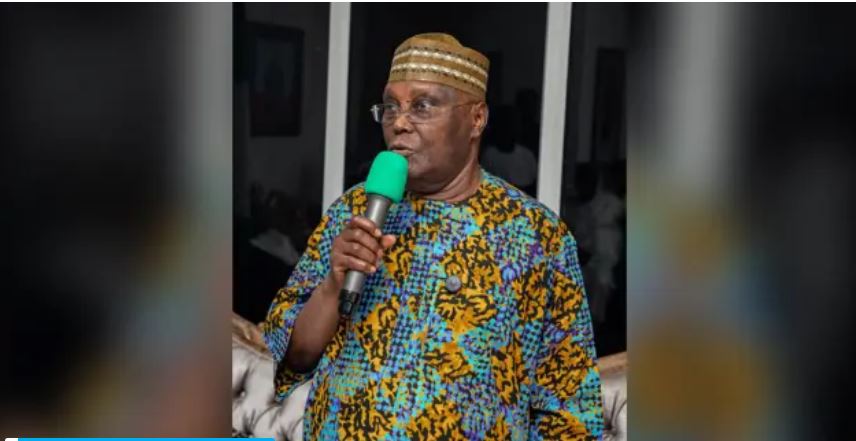
The presidential candidate of the African Democratic Congress (ADC), Atiku Abubakar, has insisted he will restore targeted petrol subsidy if elected, as the Presidency questioned its funding and estimated annual cost at N19.1tr for the country.
Atiku argued that subsidy removal had pushed more Nigerians into poverty, stressing that the government’s responsibility was to protect the welfare of citizens.
He said Nigeria was rich enough to provide relief for its people and pledged to improve both economic and physical security if elected.
Atiku said that rising fuel prices had increased transport and food costs, placing greater pressure on households. He promised that he would support local production, help businesses grow and make wages more valuable for Nigerians.
In a video shared on his X account, Atiku added: “We are competing with thieves. They stole the election. Now they have stolen the economy. They have stolen everything.”
The former vice president also challenged President Bola Tinubu to produce evidence of wrongdoing against him over the controversial $16 billion power sector expenditure, insisting that he should be investigated and prosecuted if there is a genuine case against him.
The Presidency challenged Atiku to provide details of his proposed “targeted subsidy” on petrol, demanding clarity on its cost, funding mechanism, beneficiaries and conditions for its eventual withdrawal.
The challenge followed Atiku’s latest declaration that his position on petrol subsidy had not changed and that he would restore what he described as a “targeted subsidy” if elected president.
The Special Adviser to the President on Information and Strategy, Bayo Onanuga, said the former vice president’s position had raised fundamental questions about the viability and consistency of his proposed petroleum policy.
Onanuga, in a statement yesterday, said the conflicting explanations emanating from Atiku’s camp within one week had made it necessary for the former vice president to explain precisely what he intended to do.
Atiku’s spokesperson, Paul Ibe, had initially said the former vice president would restore petrol subsidy if elected and subsequently phase it out, describing the measure as a temporary intervention to give Nigerians and businesses room to recover.
However, another senior aide, Phrank Shaibu, later described Ibe’s statement as an “unauthorised and misleading characterisation” of Atiku’s position.
Shaibu said Atiku would not commit to a predetermined date for ending the subsidy, arguing that it should remain until domestic refining capacity expands, supply stabilises, competition deepens and market forces are able to deliver affordable prices without government support.
Atiku subsequently intervened, insisting that his position “has not changed” and reaffirming his commitment to restoring a targeted subsidy.
The development, according to Onanuga, exposed what he described as a lack of clarity in the former vice-president’s policy prescription.
“If Atiku’s position has not changed, why did one of his principal aides say the subsidy would be temporary and phased out? Why did another senior aide have to publicly disown that explanation and introduce a completely different framework based on market conditions? And why did Atiku then step in to reaffirm the original position?” he asked.
The presidential aide said Nigerians deserved a clear and costed proposal rather than shifting explanations.
He specifically challenged Atiku to state how much the proposed subsidy would cost, who would benefit, how beneficiaries would be identified, how the intervention would be funded and what economic conditions would trigger its eventual termination.
“Nigerians cannot afford another opaque and potentially costly subsidy regime dressed up in new language,” Onanuga said.
He also questioned the economic assumption that lower petrol prices alone would substantially resolve the country’s cost-of-living crisis.
According to him, petrol prices are influenced by several factors, including international crude oil prices, exchange rates, refining costs, transportation and distribution expenses.
While competition could improve efficiency and reduce margins, he argued, it could not completely insulate Nigeria from global crude oil prices and other market costs.
Onanuga further faulted what he described as an oversimplification of the relationship between petrol prices and food inflation.
He acknowledged that energy and transportation costs affect food prices but said petrol prices were not the sole drivers of food inflation.
Other factors, he noted, include agricultural productivity, insecurity, exchange rates, logistics, storage, flooding, input costs, money supply and broader supply constraints.
The presidential aide also raised questions about the structure of crude oil refining and the implications of subsidising only petrol.
He noted that a barrel of crude produces several refined products, including diesel, aviation fuel, kerosene, petrochemical feedstocks, asphalt, hydrocarbon gas liquids, lubricants, waxes, petroleum coke and sulphur.
“Will Atiku subsidise all these by-products of the barrel as well, since kerosene is used by the underprivileged to cook, and many homes and factories use diesel to power generators and delivery trucks?” he asked.
Onanuga also questioned whether refineries supplied with discounted crude under the proposed arrangement would retain the proceeds from other refined products while government support was concentrated on petrol.
He recalled that diesel was deregulated in 2004 during the administration in which Atiku served as vice-president, while kerosene and aviation fuel were subsequently deregulated.
He therefore urged the former vice president to explain the fiscal and economic rationale behind his proposed subsidy regime.
The presidential aide said the country needed a coherent, transparent and sustainable petroleum policy rather than what he described as “policy somersaults, incoherence, destructive populism and election gimmicks.”
Atiku’s subsidy plan will cost Nigeria N19.1tr yearly, says Ogra
SIMILARLY, the Senior Special Assistant to the President on Digital and New Media, Otega Ogra, said the subsidy plan of Atiku Abubakar would cost Nigeria N19.1 trillion yearly.
Ogra made the claim yesterday while appearing on a TVC News programme.
He said the former vice president’s proposal would amount to putting public funds in the hands of billionaires.
“So for Alhaji Atiku, my question to you here is, where are the barrels for your subsidy going to come from? Where is the money that you’re going to give to your billionaire friends using your own plan?” Ogra said.
He said Atiku’s proposed subsidy programme would cost the country N19.1 trillion yearly, according to estimates, adding that the plan failed to specify the cost, subsidy cap or volume of crude oil required.
“You failed to put the estimates in your plan, you failed to put the cap in your plan, you failed to put how many barrels of oil Nigeria is going to need in your plan,” he said.
According to Ogra, with crude oil selling at $80 per barrel, Nigeria would need to subsidise each barrel by about $40.
“So calculate that. It comes to about N19.1 trillion per year, N52.3 billion daily, N1.5 trillion monthly. And for every time you breathe or before you even complete a breath, it’s going to cost you N605,000 per Nigerian,” he said.
Ogra said the N19.1 trillion could also fund the N70,000 minimum wage for 22 million Nigerians for a year, based on the amount shared through the Federation Account Allocation Committee (FAAC) in July.
He said one of the major achievements of the administration was ending what he described as the practice of spending money the country did not have.
Ogra said the economy had been characterised by rent-seeking before President Bola Tinubu assumed office in 2023 and introduced his reforms.
“A few Nigerians were taking all the commonwealth of Nigerians, using various fraudulent schemes like the FX arbitrage that was there, the rent-seeking on the subsidy programmes.”
He described Atiku’s position that he would reintroduce subsidy as “a very ignorant take” that showed “a lack of knowledge”.
Atiku demands subsidy accountability, challenges Tinubu to prove $16b claim
MEANWHILE, Atiku, in a statement issued yesterday by his Senior Special Assistant on Public Communication, Phrank Shaibu, accused the Tinubu administration and its supporters of resurrecting decades-old allegations as a diversion from growing demands for accountability over the management of funds saved from the removal of petrol subsidy.
The former Vice President said the renewed focus on the power sector, privatisation and public assets was an attempt to change the subject at a time Nigerians were demanding to know what had happened to the resources accruing to government after subsidy was removed.
“The National Assembly investigated the power projects. I was never invited to answer any allegation of wrongdoing,” Atiku said.
He acknowledged that he chaired the National Council on Privatisation during his tenure as Vice President but maintained that he did not oversee the implementation of the power project.
“The responsible minister did. The same applies to the Aluminium Smelter matter. I have repeatedly asked to be investigated. I left office in 2007 and have spent much of the period since then opposing governments in power. If there is evidence that I stole public money, why has no government produced it before a court?
“It is still not too late. Investigate me. Invite me. Produce the evidence. Prosecute me if you have a case. But propaganda cannot substitute for evidence”, he added.
The Presidential candidate of the African Democratic Congress argued that the renewed allegations were coming amid his sustained criticism of the government’s handling of the economic consequences of petrol subsidy removal.
According to him, Nigerians were told that the removal of subsidy would free resources for development, but citizens had instead been subjected to higher living costs.
“Today, petrol is more expensive, transportation is more expensive, food is more expensive and the purchasing power of the Nigerian worker has been devastated,” he said.
Atiku further questioned the management of increased government revenues, alleging that fiscal incentives, waivers, tax credits and concessions remained available to powerful economic interests.
“So our question remains brutally simple: where is the people’s money?” he asked.
He accused the administration of hypocrisy for withdrawing what he described as relief from poor Nigerians while defending interventions for powerful economic interests as incentives.
Atiku also dismissed what he described as sponsored social-media attacks, insisting that the allegations would not stop him from demanding accountability or advocating policies aimed at restoring Nigerians’ purchasing power.
“The people who removed subsidy from the poor cannot frighten us into silence by resurrecting allegations that governments with all the investigative machinery of the Nigerian state have had nearly two decades to establish,” he said.
“If you have evidence against Atiku, bring it. If you have a case, prosecute it. But if you have neither, stop manufacturing distractions and answer Nigerians: You removed the subsidy. You collected the savings. Where is the money?” he queried.
Accord presidential candidate pledges petrol price of N605 per litre
RELATEDLY, the presidential candidate of the Accord Party, Gbenga Olawepo-Hashim, has said Nigerians would pay no more than N605 per litre for petrol under an Accord administration, with the price potentially falling to N200 if production costs and the exchange rate improve.
Hashim said the N605 price would be a sustainable starting point rather than an artificially subsidised rate, adding that reducing the pump price would not affect government revenue or Federation Account Allocation Committee (FAAC) revenues.
“N605 per litre is our starting sustainable price for petrol. Nobody will buy petrol above N610 under our government. It could be as low as N200,” he said.
He said achieving the price would require fundamental changes to Nigeria’s petroleum cost and accounting structure rather than another opaque subsidy regime.
Hashim, who has consistently opposed the removal of petrol subsidy, described the justification previously offered for its removal as “accounting magic”.
He argued that Nigeria must first establish the actual cost of producing, refining, transporting and distributing petrol before determining whether the government is subsidising consumers.
“Any time you sell a product above its legitimate cost of production, refining, transportation and insurance, you cannot call the difference between that price and an international benchmark a subsidy loss. That is opportunity cost,” he said.