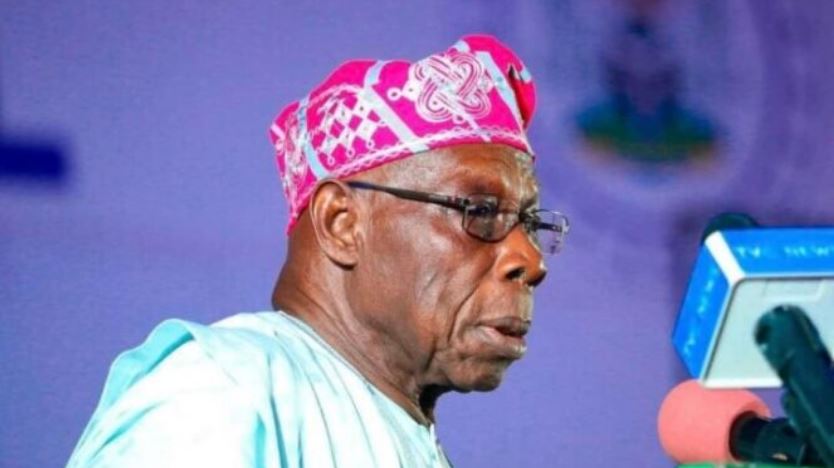
Former president Olusegun Obasanjo has described the 1967 Asaba massacre as one of the most painful and terrible episodes of the Nigerian civil war.
Obasanjo spoke virtually on Wednesday as chairman of the occasion, at the 59th anniversary memorial of the massacre in Asaba, the Delta state capital.
“This marks the remembrance of one very sad aspect of the Nigerian civil war. Of course, the war in its entirety was an unfortunate event which should never happen,” he said.
“But the Asaba Massacre, as it is called, was one of the most painful, one of the most terrible aspects of that war.”
‘I WEPT AFTER READING DOCUMENTS’
Obasanjo said he was moved to tears after receiving documents on the massacre from Chuks Nduka-Eze, convener of the Asaba Massacre Memorial.
He said he was saddened that such an event occurred “in my own country, in my lifetime”.
The ex-military ruler urged survivors and victims’ families to embrace forgiveness and reconciliation.
“To all of you assembled: let us keep one thing in mind — forgiveness, forgiveness, and forgiveness again,” he said.
Obasanjo also called for the tragedy to be remembered as part of efforts to avoid a recurrence.
Responding to Obasanjo’s appeal, Epiphany Azinge, Asagba of Asaba, said the community could forgive without forgetting the massacre or abandoning its demand for accountability.
“We may not forget, but certainly, we have to forgive,” Azinge said.
The monarch, however, said there could be no closure or healing until a sitting Nigerian president publicly apologises to the people of Asaba.
“There will be no closure, there will be no healing until a sitting President — not an ex-President, but a sitting President — publicly apologises to us,” he said.
Azinge said former military head of state Yakubu Gowon had apologised while out of office.
The Asagba also questioned Obasanjo’s appeal for Nigerians to say “never again”, recalling the Odi killings during Obasanjo’s administration.
“Coming from him, I was a bit taken aback. How long do we say ‘never again’? But it happened at Odi,” he said.
ASAGBA FORGIVES TAIWO FAMILY
Despite his demand for a presidential apology, Azinge publicly proclaimed forgiveness for the family of Colonel Ibrahim Taiwo, who was associated with the military operation during the massacre.
“On behalf of the Asaba community, and as the prescribed authority — the Asagba of Asaba — I hereby publicly proclaim that we have forgiven the Taiwo family,” he said.
The monarch said the community had accepted the apology offered by retired Major General Ahmed Taiwo, son of Colonel Taiwo.
Taiwo had expressed regret and apologised on behalf of his father and family for any act, omission or commission that contributed to the massacre.
“I know it will not right the wrong, but I believe and pray it is a start towards reconciliation,” he said.
The 59th anniversary memorial also called for national recognition of the massacre and the establishment of a permanent memorial centre ahead of next year’s 60th anniversary.
The Asaba massacre occurred between October 5 and 7, 1967, in Asaba, present-day Delta state, during the Nigerian civil war.
The massacre targeted civilians in Asaba, most of whom were Igbo, and was carried out by the Nigerian Army’s second infantry division.