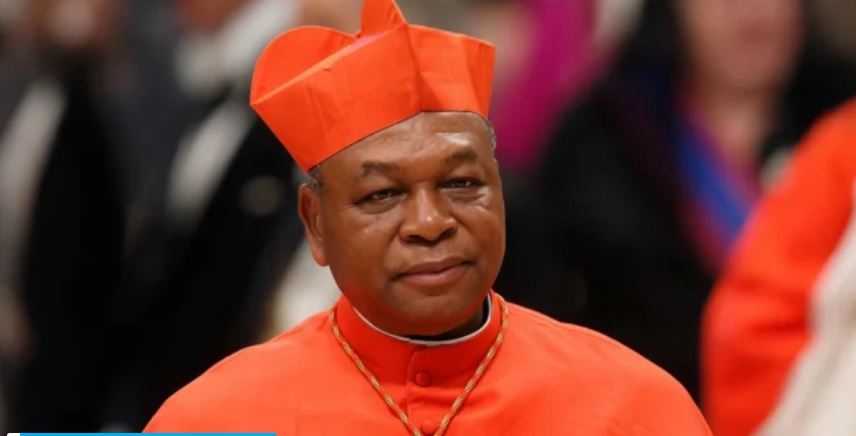
One week after President Bola Tinubu’s meeting with the Catholic Bishops’ Conference of Nigeria (CBCN), the row over the Presidency’s criticism of Cardinal John Onaiyekan has continued to elicit reactions, reigniting the fragile church-state tension ahead of the 2027 general elections.
The Catholic Bishops’ Conference of Nigeria had met with Tinubu at the Presidential Villa, where concerns over hardship, the state of the economy, fairness in the political space and the 2027 elections were raised.
Presidential candidate of the Nigeria Democratic Congress (NDC), Peter Obi, yesterday criticised the Federal Government over its response to recent comments by the CBCN, accusing the Tinubu administration of becoming increasingly intolerant of criticism instead of addressing the country’s mounting economic and security challenges.
In a statement titled “When a Government Declares War on the Truth,” Obi said Nigeria’s worsening insecurity, poverty, inflation and unemployment require honest engagement rather than attacks on those who draw attention to the nation’s realities.
He argued that the Catholic Church has never acted as a political opposition, noting that the Catholic Bishops’ Conference has consistently served as the nation’s moral conscience by commending governments when necessary and speaking out whenever justice and the public good were threatened.
According to him, other major religious bodies, including the Christian Association of Nigeria (CAN), the Nigerian Supreme Council for Islamic Affairs (NSCIA), Jama’atu Nasril Islam (JNI) and the Supreme Council for Shari’ah in Nigeria (SCSN), have similarly expressed concerns over the country’s worsening socio-economic conditions because they interact daily with citizens affected by hardship.
Obi maintained that leaders should welcome constructive criticism instead of treating every dissenting voice as political opposition. He recalled that even under military rule, religious leaders were not vilified for speaking truth to power, citing the 1998 visit of Pope John Paul II to Nigeria when the late pontiff openly challenged the regime of General Sani Abacha over democratic governance and the detention of Chief Moshood Abiola.
Obi also questioned what he described as a contradiction in the Federal Government’s relationship with the Catholic Church, noting that President Bola Tinubu had demonstrated respect for the institution by attending the inauguration of Pope Leo XIV in Rome, only for his aides and supporters to later launch attacks on senior Catholic clerics at home.
He accused government officials of attempting to reduce national concerns raised by the bishops to a religious issue, insisting that insecurity, inflation, unemployment and poverty affect Nigerians irrespective of faith or ethnicity.
In the same vein, Obi’s running mate in next year’s election and former governor of Kano State, Rabi’u Kwankwaso, has thrown his weight behind Catholic Bishops. Kwankwaso, in a post on his verified X handle, lauded the Bishops for demonstrating what he described as ‘courage and patriotism’ by drawing attention to the realities confronting Nigeria.
He dismissed the insinuation that the Bishops’ concerns regarding the rising cost of living, worsening insecurity, declining public confidence, and the hardship faced by millions of Nigerians were partisan.
The former Kano State governor added that the clerics’ concerns reflect the daily experiences of ordinary citizens across every region of the country.
He lamented that millions of Nigerians continue to struggle under the weight of economic hardship, unemployment, insecurity, poor access to quality education and healthcare, and diminishing opportunities despite the country being blessed with abundant human and natural resources.
According to him, the challenges demand urgent, sincere, and people-centred responses from those entrusted with leadership.
HOWEVER, in defence of the president, former Abia State Governor and Senator representing Abia North, Orji Uzor Kalu, has said President Tinubu owes the Catholic Church no apology over his recent remarks following the meeting between the President and Catholic bishops.
Kalu, who is a Catholic and a member of the ruling All Progressives Congress (APC), said he did not believe Tinubu had insulted the Catholic Church or its leadership, insisting that the President had maintained a cordial relationship with the Church.
The former Senate Chief Whip spoke on Channels Television’s Politics Today on Wednesday while reacting to criticisms of the Tinubu administration by some Catholic leaders, including Cardinal John Onaiyekan. He dismissed the suggestion that Tinubu had disrespected the Catholic Church, arguing that the Church had historically played the role of the conscience of the nation by speaking truth to successive governments.
He said Catholic bishops had consistently commented on the state of the nation under successive military and civilian administrations and that he saw nothing wrong with their engagement with the President.
According to him, “what politicians cannot tell President Tinubu, the Catholic bishops can tell him.” Kalu said the bishops’ meeting with Tinubu was therefore a positive development because the clergy could raise issues before the President without being constrained by partisan considerations.
He further argued that Tinubu had maintained a good relationship with the Catholic Church, saying the President had continued to grant the bishops access whenever they sought an audience with him.
The former governor also defended Tinubu against calls for an apology over the controversy, stating categorically that the President had not made any statement that warranted one.
“Do you think that the presidency should apologise to the Catholic Church?” he was asked. Kalu replied: “The President didn’t say anything that needs apology.”
On the controversy surrounding Cardinal Onaiyekan’s public comments after the meeting with Tinubu, Kalu said the Cardinal had a history of speaking critically about governments, regardless of who was in power.
He noted that Onaiyekan had criticised successive administrations dating back to the military era, adding that his position should not automatically be interpreted as the official position of the Catholic Bishops’ Conference.
Kalu said Onaiyekan was not necessarily speaking on behalf of the entire Catholic Bishops’ Conference when he made his subsequent public comments. He therefore rejected suggestions that the Cardinal’s remarks amounted to an indictment of the President or proof that Tinubu had fallen out with the Catholic Church.
The senator also rejected claims that the President was detached from the reality of the hardship facing Nigerians. He argued that Tinubu was regularly briefed on developments in the country and had continued to engage with different stakeholders.
IN a more poignant reaction to the growing tensions amid renewed objections to the ruling party’s same faith ticket, Secretary to the Government of the Federation (SGF), Senator George Akume, has said that the numerous challenges facing the country can only be addressed through sustained partnership with faith communities, traditional institutions, civil society organisations, the private sector and citizens.
In a statement on the recent engagement between President Tinubu and the leadership of the Catholic Bishops’ Conference of Nigeria, Akume noted that the administration of President Tinubu would continue to deepen consultations with the CBCN, other faith-based organisations and relevant stakeholders on issues affecting the country, adding that government remains open to honest counsel and would continue to govern with openness, accountability and evidence-based policies.
He assured that the Tinubu administration is neither seeking nor in support of a one-party state, just as it remains deeply respectful of the independence of the Independent National Electoral Commission (INEC), in the spirit of true democracy.
Akume stated that the government is sustaining dialogue and conflict prevention through the Nigeria Inter-Religious Council (NIREC), describing collaboration with religious institutions as indispensable to advancing the national interest.
The SGF observed that the Federal Government had taken note of public reactions following the meeting between President Tinubu and the Catholic Bishops, using the opportunity to reaffirm its profound respect for the Catholic Church and its enduring contributions to Nigeria’s development through education, healthcare, humanitarian services, peacebuilding and moral guidance.
He stressed that the government recognised the Church as one of Nigeria’s most important development partners and acknowledged that, like all faith communities, it had both the right and responsibility to speak on issues affecting the welfare of citizens and the country’s future.
Addressing security, Akume admitted that the true measure of government policy remained the safety experienced by citizens in their homes, farms, schools, markets, places of worship and on highways.
He said every life lost to terrorism, banditry, kidnapping and other violent crimes was regrettable, adding that the government was expanding and fine-tuning the country’s security architecture with encouraging results.
IN another development, the Sultan of Sokoto, Alhaji Muhammad Sa’ad Abubakar, has called for an immediate investigation into the killing of an Army officer, identified as Col. Abdussalam Ude.
The President-General of the Nigeria Supreme Council for Islamic Affairs also condemned what he described as persistent hate and discrimination against minority Igbo Muslims in the South-East, urging an end to attacks on religious minorities across the country. His position was contained in a statement issued on Wednesday by Prince Bashir Adefaka on behalf of the Sultan’s Media Team.
The Sultan described the reported hostility towards minority Igbo Muslims in the South-East as a setback to national unity and urged the Federal Government and the Armed Forces to uncover the circumstances surrounding the officer’s death.
According to the statement titled “Sultan of Sokoto calls for immediate launch of investigation on alleged assassination of Igbo Muslim Army officer,” Alhaji Abubakar made the call “while reacting to the recent assassination, allegedly, of Nigeria’s most senior Igbo Muslim Army officer, which occurred at his residence in Abuja, Nigeria’s capital, recently.”
The Sultan said: “The Federal Government and the Armed Forces of the Federal Republic of Nigeria have gotten to put heads together and get to the roots of circumstances that led to the shooting at alleged close range of Army Colonel Abdur-Razaq AbdlKarim Ode, a fine military intelligence officer that both Muslim Ummah and traditional communities in the country, especially the region he hailed from, were proud of.”
He added that failure to investigate the killing of any Nigerian, particularly a serving military officer, would undermine efforts at nation-building.
“To allow the killing of any single Nigerian soul taken out without getting to the root of the cause and bringing the culprits to justice with a view to disallowing a repeat of the same is not a good way to talk about a serious country, much more when the life extrajudicially taken is that of a soldier of the Federal Republic of Nigeria.
“The cause of this killing and attempt on the life of his family must be found out and the government and other appropriate quarters do the needful,” he said.