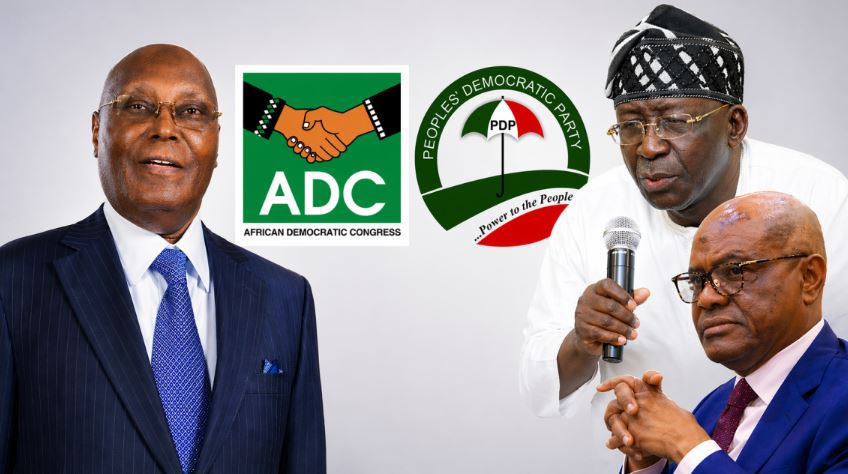
Former Vice President Atiku Abubakar may have just set the tone for another round of political tension, this time outside the Peoples Democratic Party (PDP).
In a recent interview on Arise TV, Atiku hinted at a fresh presidential bid in 2027, this time on the platform of the African Democratic Congress (ADC).
The party has other heavyweights and possible contenders, including former Labour Party presidential candidate and former Anambra State Governor, Peter Obi; former Minister of Transportation and former Rivers State Governor, Rotimi Amaechi; and former Kano State Governor, Rabiu Kwankwaso.
The interview revealed that the former vice president is not ready to drop his long-standing ambition, which some fear may ultimately lead to the implosion of the ADC, just as it did his former party.
Responding to a question in the Arise TV interview on whether turning 80 by the next election would influence his ambition, Atiku, who was born in November 1946, said, “Certainly yes, because the stakes are higher and I believe that will be my last outing.”
In Nigerian politics, there is an unwritten agreement that the presidency should alternate between the North and the South to ensure national stability and inclusion.
Many see Atiku’s relentless insistence on running as injurious to that delicate consensus. His decision to run in 2023 was particularly controversial because it went against the PDP constitution, which favoured a southern presidency following the eight-year tenure of Muhammadu Buhari, a northerner.
This perceived betrayal led to significant grumbling among southerners and sparked the emergence of the Nyesom Wike-led rebellion within the Peoples Democratic Party, a fracture that has driven the party to the brink of extinction.
There is now a growing fear that a similar scenario may emerge in the ADC, potentially crippling the party’s chances before the contest even begins.
Indeed, Atiku’s story in the PDP has become a classic political tragedy, in which a giant cracked the foundation of the house he helped build.
The PDP, which once described itself as the “largest party in Africa,” found itself stumbling over the very ambitions of one of its founders.
When the party was formed in 1998, it quickly became Nigeria’s dominant political force, ruling the country for 16 uninterrupted years.
Over time, however, the PDP evolved into a platform where internal power competition became intense. The party, which used to be a vibrant machine of consensus, critics say, slowly became a vehicle for a single man’s ambition. As the 2027 cycle approaches, Atiku’s recent defection to the ADC feels to many like the final abandonment of a house he helped build.
Decades of ambition
Atiku’s presidential journey did not begin with the PDP. His first attempt dates back to 1993 under the Social Democratic Party (SDP), during the military transition programme. Although he eventually stepped down for Moshood Abiola, the experience positioned him within Nigeria’s emerging democratic elite.
Upon the restoration of democracy in Nigeria, Atiku won the Adamawa governorship election on the PDP’s ticket. However, before he dropped the mandate after the PDP presidential candidate, former military ruler Olusegun Obasanjo, picked him as his running mate, thus becoming the nation’s vice president from 1999 to 2007.
During his eight years in office, he built a nationwide political structure that would later sustain his ambitions.
His first full presidential run came in 2007 after defecting to the Action Congress (AC) following a fallout with Mr Obasanjo. He lost that election to the late President Musa Yar’Adua of the PDP.
In 2011, he returned to the PDP to seek the ruling party’s ticket but was defeated in the primary election by Goodluck Jonathan, then the incumbent president.
Ahead of the 2015 elections, Atiku joined the All Progressives Congress (APC), where he lost the primaries to Muhammadu Buhari, who went on to win the presidency.
He returned to the PDP once more and secured its ticket in 2019, only to lose again to Mr Buhari in the general election.
In 2023, Atiku was once again the PDP’s presidential candidate, reinforcing both his staying power and the concerns of critics who believed the party had become locked in a cycle of familiar choices. He lost the general election to President Bola Tinubu of the APC.
However, in a fresh twist that underscores his long pattern of political movement, Atiku defected from the PDP to the ADC to run for president on the platform of his new party in 2027.
For some within the PDP, his exit provides an opportunity for an internal reset and a possible generational shift. For others, it represents yet another chapter in a long history of departures that have left the party grappling with identity and cohesion.
This long trajectory, spanning the SDP, PDP, AC, APC, and ADC, captures not just political persistence but also a pattern of movement that some party insiders interpret as destabilising.
The road to 2023: A party at war with itself
After Atiku secured the PDP presidential ticket in May 2022, defeating several contenders, including then Rivers State Governor Nyesom Wike, the party failed to close ranks.
What followed was one of the most damaging internal rebellions in the party’s history.
A group of five influential governors, later known as the G5, refused to support Atiku’s candidacy. Their opposition was rooted in what they described as a violation of the party’s zoning principle, arguing that both the presidential candidate and the national chairman, coming from the North, upset the PDP’s internal balance.
The perception grew that Atiku’s insistence on being the candidate, even when the political climate demanded a shift to the South, was not an act of service, ultimately draining the party’s energy.
The G5: Rebellion within
The G5, also known as the “Integrity Group,” consisted of five sitting PDP governors whose influence spanned key regions. They became the faces of a rebellion that the PDP could not suppress.
Mr Wike, the then-governor of Rivers State, emerged as the group’s leader and most vocal figure, leveraging his control of a politically strategic state.
Known for his “tell-it-like-it-is” style and his mastery of grassroots politics, Mr Wike, currently the FCT minister, was the engine room of the group. He felt personally betrayed after losing the primary to Atiku and being passed over for the vice presidential slot.
Then there was Seyi Makinde of Oyo State, the group’s intellectual. His opposition meant the party had no solid footing in one of the country’s most important electoral zones.
Samuel Ortom of Benue State was a man who often spoke about the survival of his people in the Middle Belt. His endorsement of an alternative candidate, specifically Peter Obi, signalled that Atiku’s northern identity was not enough to secure his own backyard.
In the South-east, Ifeanyi Ugwuanyi of Enugu State and Okezie Ikpeazu of Abia State completed the group, giving it both geographic spread and political depth.
These five men did not just withhold their support; they actively worked to ensure that Atiku had no support in their territories, and the results reflected that.
They controlled party structures, state resources, and voter mobilisation networks. Their refusal to support Atiku and, in some cases, their indirect alignment with opposition candidates, dealt a major blow to the PDP’s campaign.
Their demand was simple: if the presidential candidate was from the North, the party chairman must come from the South.
The group insisted that the party’s national chairman, Iyorchia Ayu, resign to restore regional balance. When that did not happen, with Mr Ayu insisting on completing his four-year term, the standoff hardened, leaving the PDP fractured heading into the polls.
The impact was devastating. For months, while the APC was consolidating its base, the PDP was fighting a “civil war” on national television. Instead of campaigning against the ruling party, the PDP spent its time trying to appease five men who had already mentally checked out of the campaign. This internal friction acted like a slow-release poison, paralysing the party.
The math and the narrative of loss
When the dust finally settled on the 2023 election, the numbers told a story of “what could have been.”
According to the Independent National Electoral Commission (INEC), Atiku received 6,984,520 votes, placing second to Mr Tinubu. Mr Obi, the former PDP member who had left to fly the Labour Party’s flag, polled 6,101,533 votes to come third.
On the surface, this was a strong showing. However, within the PDP, the numbers told a more troubling story. The combined effect of internal division, voter realignment, and the rise of a credible third force significantly weakened the party’s electoral strength.
The PDP, in many ways, was forced to choose between romanticism and realism. Romanticism meant sticking with Atiku, a familiar figure with national name recognition, political structure, and experience. He had contested before, built alliances, and understood the electoral terrain.
Realism, however, pointed to the need for a generational shift, regional balance, and perhaps a different kind of candidate who could unify the party and appeal to a changing electorate.
The perception remains that had Atiku stepped aside for a younger or southern candidate or had he managed to keep the party united, the PDP would have cruised to victory. Instead, the party’s base was split in three directions: those who stayed with Atiku, those who followed Mr Obi, and those who followed the G5’s lead toward the APC.
The Exit: From PDP to ADC
The ultimate proof of this “crippling” may have come in 2025, when Atiku officially left the PDP. After decades of being the party’s face, he defected to the ADC.
To his critics, this was the final act of a man who loved the presidency more than the party. Having used the PDP’s resources and platform for years, he walked away when the party’s internal structures, weakened by the very crises he sparked, could no longer guarantee him a seventh ticket.
Atiku’s move to the ADC, taking a significant chunk of his loyalists with him, has left the PDP as a shell of its former self.
Mr Wike, reacting, once said, “If I were his son, I would sit him down and ask: ‘Dad, how can you keep hopping from one party to another at almost 80 years old?’”
The Senior Special Assistant on Media to Mr Wike, Lere Olayinka, also criticised Mr Atiku, saying, “My first reaction? Good riddance to bad rubbish. The media headline should read: ‘Atiku Leaves PDP Again’ because he’s done this since 2007. He is the spoiled apple that infected our party’s basket.”
Similarly, Sule Lamido, former Jigawa State Governor, said, “You leave a party with a strong history and foundation and go to a smaller platform because you think you are powerful enough to take it over. That raises serious questions about the kind of leadership such people want to offer the country.”
But the man does not see it the way his critics do.
While many argue that Atiku’s repeated presidential ambitions weakened the PDP, the former vice president has consistently argued that defections, alliances, and political realignments are not unusual in a democracy.
In a statement, he said, “Let me be unequivocal: freedom of association and expression are not optional in a democracy; they are fundamental rights.
“Defections, alliances, and realignments are part and parcel of democratic politics. We’ve seen them before, and we’ll see them again,” he said.
In his view, such movements reflect the fluid nature of Nigeria’s political system rather than instability caused by any one individual.
When he left the PDP, he cited what he described as “irreconcilable differences” within the party, arguing that the organisation had drifted from its founding ideals.
On his repeated bids for the presidency, Atiku has also pushed back against suggestions that he is driven by personal desperation.
He has insisted that his ambition is rooted in what he describes as a commitment to national development, frequently arguing that leadership change is necessary to address Nigeria’s economic and governance challenges.
Did Atiku “cripple” the PDP?
The claim that Atiku’s ambition crippled the PDP is both compelling and contested.
On one hand, his repeated presidential bids arguably contributed to internal fatigue and factionalism. His emergence as a candidate in 2023, amid zoning disputes, triggered one of the party’s most damaging internal crises.
The “crippling” effect has left the party struggling to act as a potent opposition.
With Atiku now done with the PDP, his battle to become Nigeria’s president shifts to the ADC where he is considered a frontrunner for the party’s ticket.