
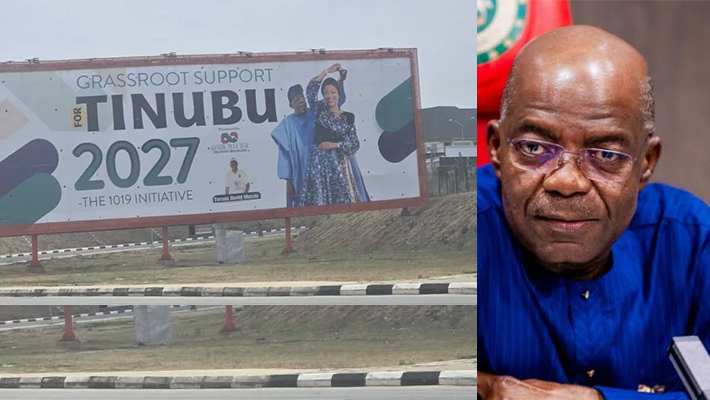
The Abia government says every political party’s presidential candidate intending to campaign through billboards and posters will pay N200 million to obtain a campaign advertising permit.
The Abia State Structures for Signages and Advertising Agency (ABSSAA) disclosed this on Wednesday in Aba, during a stakeholders forum on political campaign advertising fees.
Ndubuisi Nwaogwugwu, ABSSAA’s head of strategy, innovation and design, announced the rate on Wednesday in Aba. He stated that the permit rates schedule applied to all political party candidates at all levels in Abia and was based on ABSSAA and other Abia Laws regulating signage and advertising.
“Presidential candidates will pay N200 million, Governorship candidates will pay N150 million, Senatorial candidates will pay N100 million, House of Representatives and Assembly candidates will pay N50 million and N20 million respectively,” said Mr Nwaogwugwu.
According to him, the Abia government approved the schedule of ‘Political Campaign Advertising Permit Fees’, and it applied “throughout the approved election campaign period”.
Onyebuchi Ememanka, the director-general of Strategic Communications Bureau, stated that the permit schedule was non-negotiable, saying, “It is about protecting lives on our roads, preserving the beauty of cities, and protecting the integrity of our democratic process. Dr Alex Otti’s leadership is determined to provide an enabling environment for political engagement with clear rules, transparent processes and equal access. Please note this, for the avoidance of doubt – the Abia Government will not discriminate against any political party or any candidate.”
He explained that provided rules were obeyed, official guidelines followed, and appropriate fees paid, every party’s candidate would enjoy the same opportunity to engage the public using outdoor spaces advertising.
Mr Ememanka also mentioned that when parties chose compliance over chaos, 2026 would become a clear blueprint for a decent and mature political campaign period that set future standards of sustainable, strategic engagements.
Sola Akinsiku, the president of the Out-of-Home Advertising Association of Nigeria (OAAN), pointed out that the association had reservations about the schedule of campaign advertising presented by the Abia government.
Mr Akinsiku said that the association supported mutual partnership, justice, equity, and fair play, and desired activities that showcased the realities of the Nigerian economy.
He, however, said that the rates were unsustainable and could affect political advertising, resulting in poor voter literacy, voter apathy, and disenfranchisement of people, which would hurt the polity more.


