
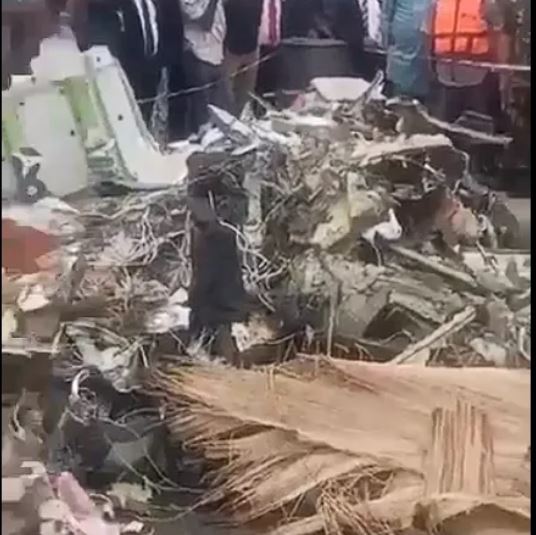
Nine days after a Nigerian Air Force aircraft crashed in Igbokoda, Ilaje Local Government Area of Ondo State, the wreckage and bodies of the 25 victims remain unrecovered, raising fears of a public health crisis as residents complain of an increasingly offensive stench from the crash site.
The development has heightened pressure on the military to accelerate recovery operations and address concerns over possible environmental contamination, with the community’s monarch and residents calling for urgent intervention by the federal and state governments.
Meanwhile, the Senate has called for a comprehensive audit of the Nigerian Air Force’s aircraft fleet and maintenance funding, while the House of Representatives has demanded an independent investigation into the October 5 crash. The NAF says it has intensified search efforts and constituted a 12-member board to investigate the incident.
The monarch of Igbokoda, Oba Afolabi Odidiomo, has urged the Federal and Ondo State governments to expedite efforts to recover the remains of victims of the Nigerian Air Force aircraft that crashed on October 5, 2026.
One week after the incident, neither the wreckage of the NAF ATR-42 aircraft nor the bodies of the 25 victims had been recovered, despite the deployment of sonar buoys and amphibious buggies for the search operation.
Odidiomo said residents had been enduring an increasingly offensive stench since the crash, which he attributed to decomposing human remains in the river. He also raised concerns about possible environmental pollution from spilled aviation fuel.
“The odour is extremely offensive. So many parts of the human body are floating around in the river. Some of the bodies have not been recovered. They have decomposed, and it is affecting everything,” the monarch said.
He added that the suspected pollution had affected residents’ access to clean water for domestic use, including cooking. He also said traces of aviation fuel could be seen on the river some distance from the crash site.
The monarch urged the authorities to accelerate the recovery of the victims’ remains and aircraft debris and commence an urgent environmental clean-up.
Responding, the Ondo State Commissioner for Environment, Mr Tob Loko, said the state government was working with the Federal Government to address the situation.
Loko said the state had dispatched a delegation to assess the environmental impact shortly after the crash, while residents and other responders had joined the recovery efforts.
He said the state was also assessing the extent of environmental contamination and its potential public health implications to determine the appropriate decontamination measures.
“Despite the number of days the recovery effort has been ongoing, no recovery has been made. None of the corpses has been recovered,” the commissioner said.
He acknowledged concerns about pollution, adding that the government was conducting a comprehensive assessment of the environmental and public health risks to ensure that appropriate measures were taken promptly.
A community leader, Segun Omogbemi, also confirmed the stench, saying it had become increasingly unbearable.
“What happened in Igbokoda is a very sad experience. Since Sunday, we have perceived this odour, very offensive. In fact, it is getting worse; we are thinking the odour is from the crash site,” he said.
Omogbemi appealed to the federal and state governments to speed up the recovery of the victims’ remains and implement appropriate measures to address the suspected pollution.
A resident, Veronica Molehin, similarly expressed concern over the worsening stench, saying it had persisted for days.
“My house is not too far from the scene of the crash; we perceive the odour here too. We have been on it since Friday, and we thought the government would have evacuated the remains of the victims, but they are still on it,” she said.
NAF intensifies search
The Nigerian Air Force says it has intensified search and recovery operations following the crash and constituted a 12-member board to investigate the incident.
The Director of Public Relations and Information at NAF Headquarters, Air Commodore Ehimen Ejodame, disclosed this in a statement on Tuesday, saying the Chief of the Air Staff, Air Marshal Sunday Aneke, had directed sustained recovery operations alongside a comprehensive investigation.
According to the statement, Air Vice Marshal E.O.E. Ebiowe, head of the Investigation and Recovery Team, is coordinating the response, while Air Vice Marshal F.O. Ankeli heads the Aircraft Accident Investigation Board.
The 12-member board comprises specialists in aviation operations, flight safety, piloting, air traffic control, aircraft engineering, maintenance and medical services. Representatives of the Nigerian Civil Aviation Authority and the Nigerian Safety Investigation Bureau are also members.
The board is expected to examine the operational, technical, environmental, human and organisational factors surrounding the crash, preserve relevant evidence and establish its immediate and underlying causes.
It will also assess the emergency response, including search and rescue, medical assistance, recovery operations and management of the crash site, before recommending measures to prevent a recurrence.
The NAF said the investigation would follow established aviation safety procedures, warning against drawing conclusions about the cause of the crash before the process was completed.
The service also announced a dedicated helpline at its headquarters, under the Office of the Directorate of Veterans Affairs, to provide the victims’ next of kin with information and clarification.
It said arrangements had been made to meet with affected families and provide other support measures during their period of grief.
“The NAF recognises the public’s legitimate interest in the ongoing process and remains committed to providing appropriate updates as verified information becomes available,” the statement said.
The Air Force extended its condolences to the bereaved families, colleagues and others affected by the crash, assuring the public that search, recovery and investigative operations remained a priority.
Audit calls
The Senate on Tuesday called for a comprehensive audit of the Nigerian Air Force’s aircraft fleet and maintenance funding following the October 5 crash in Ondo State.
It also directed relevant committees to scrutinise budgetary allocations for aircraft maintenance to determine whether funding gaps or other lapses contributed to recurring military aviation accidents.
The resolutions followed a motion sponsored by Senator Osita Ngwu, representing Enugu West.
The Senate expressed concern over recurring military aircraft crashes and the loss of personnel, raising questions about aircraft maintenance, ageing fleets, operational safety procedures and airworthiness.
The lawmakers warned that failure to conduct a transparent and comprehensive investigation could prevent the authorities from identifying the causes of the crash and taking measures to prevent a recurrence.
The chamber observed a minute’s silence in honour of the victims and extended condolences to President Bola Tinubu, the Chief of the Air Staff, the NAF, the Ondo State Government and the bereaved families.
It urged the NAF and the Nigerian Safety Investigation Bureau to investigate the immediate and underlying causes of the crash and make their findings public.
The Senate also mandated its committees on Air Force and Aviation to visit the crash site, engage NAF authorities and audit the serviceability and airworthiness of aircraft in the presidential and military fleets.
It further urged the Federal Government to prioritise funding for regular aircraft maintenance and the replacement of ageing military aircraft.
Seconding the motion, Senator Tahir Monguno, representing Borno North, called for a comprehensive audit of the NAF fleet to establish the aircraft’s serviceability, operational readiness and airworthiness.
Senator Adams Oshiomhole, representing Edo North, proposed an additional resolution directing the NAF leadership to submit its aircraft maintenance budgetary provisions to the relevant Senate committee.
Oshiomhole said the Senate needed to establish the amount allocated for aircraft maintenance.
Supporting the proposal, Senator Titus Zam, representing Benue North-West, said the inquiry should determine the amount earmarked for maintenance and whether the funding was sufficient.
Meanwhile, the House of Representatives has called for an independent investigation into the October 5 crash, citing the need for greater accountability and improved military aviation safety.
The House urged the Federal Government to ensure the timely release of approved funds for aircraft maintenance, spare parts and other essential operational needs, warning that funding and logistical constraints could compromise aviation safety.
The resolutions followed a motion of urgent public importance sponsored by Donald Ojogo (APC, Ondo) during Tuesday’s resumed plenary. The lawmakers said the proposed independent investigation should complement, rather than replace, the inquiry announced by the NAF.
They also urged the Ministry of Defence to conduct an immediate audit of military aircraft and equipment to establish their operational condition and reduce the risk of similar accidents.
The House called for posthumous commendations for the pilot and crew in recognition of their service. It also urged the government to provide appropriate welfare support and compensation to the bereaved families in line with applicable laws and policies.
Additionally, the lawmakers asked the NAF to strengthen its aircraft maintenance and airworthiness management systems, particularly for ageing aircraft, and ensure that only aircraft meeting prescribed safety standards were deployed.
Moving the motion, Ojogo described the crash, which reportedly involved 25 military personnel and crew on a flight from Benin to Lagos, as a devastating national loss.
He said the incident had plunged the country into mourning and highlighted the risks military personnel face in the discharge of their duties.
Ojogo described the crash as second only to the 1992 Hercules Air Force transport aircraft accident in Ejigbo.
He commended local divers, Nigerian Navy personnel, officials of the local government led by Maurice Oripenaye, the Ondo State Emergency Management Agency and other state officials for their response.
Despite their efforts, he said, the crash resulted in no survivors.
The lawmaker also praised the pilot’s handling of the aircraft in its final moments, citing eyewitness accounts that the plane had attempted to steer away from densely populated areas of Igbokoda.
Similarly, Alhassan Rumrum (APC, Kano), who chairs the House Committee on Air Force, highlighted the importance of aircraft serviceability to national defence, intelligence gathering, military logistics and operational effectiveness.
He said the loss of lives underscored the need for sustained investment in military aviation and stronger risk-management measures across the Armed Forces.
Rumrum warned that inadequate funding, delayed budget releases, spare-parts shortages and other logistical challenges could reduce aircraft availability and undermine operational safety.
Budget under scrutiny
The Nigerian Air Force earmarked a total of N37.10bn for aircraft maintenance across five budget cycles between 2022 and 2026, an analysis of budget documents has shown.
The figures stood at N2.56bn in the 2022 Appropriation Amendment and the same amount in the 2023 Appropriation Act. The allocation rose to N4.86bn in the 2024 Executive Proposal, N11.57bn in the 2025 Appropriation Act and N15.56bn in the 2026 Appropriation Bill.
The five figures amount to N37,103,707,547, or approximately N37.10bn.
However, the actual amounts released and spent on aircraft maintenance during the period could not be established because the relevant budget implementation and expenditure records were not available in the documents reviewed.
It therefore remains unclear how much of the budgeted funds was released to the NAF and how much was ultimately spent on aircraft maintenance.
Meanwhile, the brother of a female NAF officer who died in the crash has accused the authorities of withholding information about the tragedy, alleging that the aircraft developed a mechanical fault before its final flight.
He claimed that his sister had told him about a technical problem with the aircraft, which he said stopped briefly in Benin City, Edo State, for checks before continuing its journey to Lagos.
“There is damage control everywhere,” he said, accusing the military of downplaying the circumstances surrounding the crash.
He questioned why the aircraft was allowed to continue its journey if the reported fault had not been adequately resolved.
“I have evidence that this aircraft was coming all the way from Abuja. It stopped in Benin on Sunday night so that it could be fixed,” he said.
The allegations have not been established by an official investigation.
President Bola Tinubu has ordered an investigation into the incident, while the Federal Government declared three days of national mourning for the victims.
Experts demand oversight
An aviation analyst and member of the Aviation Round Table, Olumide Ohunayo, called for stronger collaboration between the military and civilian aviation authorities, particularly the Nigerian Civil Aviation Authority and the Nigerian Safety Investigation Bureau.
He said that although military personnel worked alongside civilian officials in air traffic management and search-and-rescue operations, cooperation with the aviation regulator and accident investigation agency remained inadequate.
Ohunayo argued that closer collaboration was necessary to identify safety lapses, investigate crashes thoroughly and prevent future occurrences.
He also questioned the effectiveness of repeated military investigations, citing what he described as a recurring pattern of accidents.
“When you have 16 accidents in 10 years, and eight in five years, it shows there’s something wrong with your system,” he said.
The analyst urged the NAF to allow civilian aviation authorities to participate in investigations into military aircraft crashes, arguing that independent oversight was essential to improving safety and accountability.
He maintained that investigations should go beyond identifying the immediate causes of accidents to examining systemic weaknesses in aircraft operations and maintenance.
“The Air Force must agree there’s a problem with their safety and operational system that needs regulatory surveillance, most importantly, audits. And that audit cannot come from the Air Force,” he said.
Similarly, aviation expert Alex Nwuba attributed recurring military aircraft accidents partly to differences between civilian and military aviation standards and weaknesses in maintenance practices.
He explained that civilian aviation authorities had limited oversight of military aviation, creating gaps between military procedures and the standards applied to civilian operators under the International Civil Aviation Organization.
Nwuba argued that maintenance shortcomings needed closer scrutiny, stressing that aircraft accidents should not be treated as an inevitable consequence of military operations.
He also questioned the operational availability of the NAF’s aircraft, claiming that only three of its ATR aircraft were operational.
According to him, reliance on spare parts taken from grounded aircraft could further undermine fleet availability and leave more planes out of service.
“We don’t have a maintenance ethic,” he said, adding that some aircraft had reportedly remained grounded for decades.
His claims about the number of operational aircraft and maintenance practices could not be independently verified from the information available.
Retired Group Captain John Ojikutu also expressed concern over the failure to recover the victims’ bodies a week after the crash.
He questioned the progress of the search-and-recovery operation, saying the continued absence of recovered bodies raised serious concerns.
“Have they brought out anything? Even the bodies, they’ve not been able to find them. That is where my worry is,” he said.


