
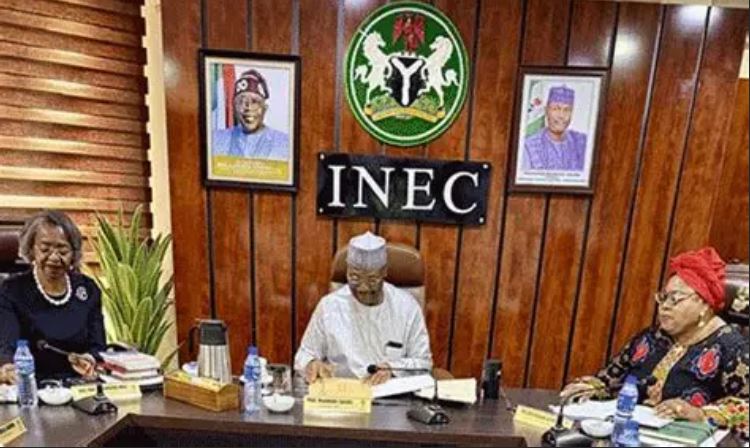
The Independent National Electoral Commission (INEC) has suspended recognition of all leadership factions of the African Democratic Congress (ADC) following a ruling by the Court of Appeal and ongoing litigation over the party’s leadership.
In a statement by its spokesperson, Mohammed Haruna, INEC said its decision followed the directive by the Court of Appeal, directing that the two warring factions of the party maintain the status quo pending the determination of a substantive suit currently before the Federal High Court in Abuja.
INEC said it also decided to stop engaging with any of the two warring factions until there’s a substantive court judgement, after it received conflicting letters from both sides, each asking to be recognised.
ADC is fast becoming Nigeria’s biggest opposition party with an alliance of somevmajor politicians in the country.
A coalition led by Atiku Abubakar adopted the party in July 2025 to field a flagbearer that would challenge President Bola Tinubu in the 2027 election.
Political bigwigs currently in the party include Atiku, Peter Obi and Rabiu Kwankwaso, who came in second, third and fourth positions, respectively in the 2023 presidential election won by Mr Tinubu.
The trio have defected from the parties on which they contested the election.
Other stalwarts in the ADC are former Senate President David Mark, who chairs one of the factions, Former Minister of Interior, Rauf Aregbesola, who serves as National Secretary, and former Minister of Youth and Sports, Bolaji Abdullahi, who serves as the party’s spokesperson.
ADC’s conflicting letters to INEC
The leadership crisis in the ADC stems from the resignation of the party’s former executives, led by Ralph Nwosu and the emergence of a new National Working Committee led by Mr Mark on 29 July, 2025.
However, Nafiu Bala, a former vice-national chairperson of the party, challenged the arrangement at the Federal High Court in Abuja, arguing that he should assume leadership in line with the party’s constitution.
On 16 March, INEC received letters from both factions, each with different requests.
Mr Mark’s group, represented by Suleiman Usman SAN & Co, asked INEC not to recognise Mr Bala as the party’s chairperson on the account that the suit was pending before a federal high court.
On the other hand, Mr Bala’s group, represented by Summit Law Chambers, asked the commission to enforce the judgment of the Court of Appeal delivered on 12 March.
Appeal Court judgement
Mr Mark’s group had filed the interlocutory appeal that was dismissed by the appellate court.
The court also ordered that the parties, including INEC, which is listed as the 4th respondent, “to maintain the status quo ante bellum and shall refrain from taking any step or doing any act capable of foisting a fait accompli on the court or otherwise rendering nugatory the proceedings before the trial court.”
The court also ordered an accelerated hearing in view of the election timetable released by INEC.
INEC’s decision
Citing this ruling, INEC said it would refrain from taking any steps that could prejudice the case.
It announced that it would remove from its portal the names of members of the party’s NWC led by Mr Mark, which had been uploaded in September, days after the suit was filed.
The commission also declined a request by Mr Nafiu’s camp to recognise him as acting national chairman pending the outcome of the case.
“The Commission shall not… receive any further communication or deal with any of the parties or groups pe
rtaining to the affairs of the party and will not monitor any meeting, congress or convention convened on behalf of the ADC by any group until the matter is decided by the Federal High Court, Abuja so as not to do any act capable of foisting a fait accompli on the court or otherwise rendering nugatory the proceedings before the trial court,” the statement said.


