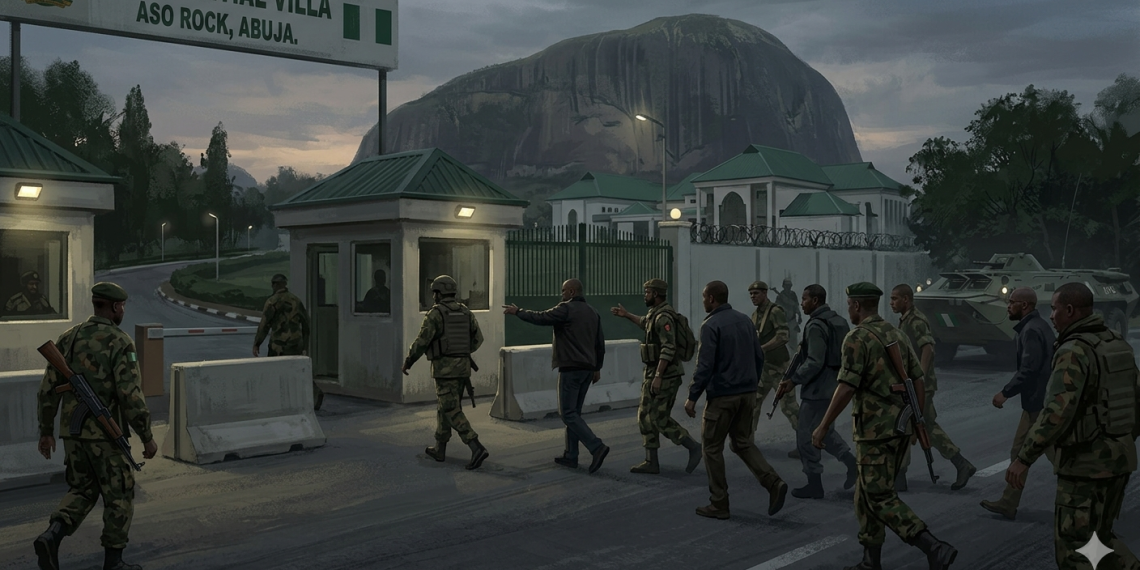
PREMIUM TIMES has obtained fresh details suggesting an elaborate plot by suspected coup conspirators to storm Nigeria’s seat of power, seize the Presidential Villa, and capture President Bola Tinubu and other top officials in a coordinated operation that spanned key military and national assets.
Findings show that beyond earlier reports of assassination plans, the alleged plotters also designed a multi-layered operation aimed at taking control of Aso Rock and other key locations, neutralising top military leadership, and decapitating Nigeria’s command and leadership structures.
At the heart of the alleged conspiracy was a plan to overrun the Presidential Villa in Abuja, Nigeria’s most fortified political stronghold, and capture President Tinubu, along with Vice President Kashim Shettima.
Senate President Godswill Akpabio and House Speaker Tajudeen Abbas were also to be captured and possibly eliminated.
Investigators say specific officers were detailed to lead the assault on the Villa, forming what sources described as the “decapitation unit” of the operation.
The alleged plan extended beyond political leaders to include key security figures such as National Security Adviser Nuhu Ribadu, then Inspector-General of Police Kayode Egbetokun, and State Security Service Director-General Adeola Ajayi, all of whom were marked as high-value targets.
According to this newspaper’s multiple reliable insiders, the operation was structured like a full-scale military takeover, with units assigned to seize strategic installations simultaneously.
While one team moved on the Presidential Villa, another was tasked with taking control of the Niger Barracks, a critical military formation overlooking the presidential Villa and housing the country’s top military chiefs.
There, specific officers were allegedly assigned to eliminate top-ranking officers, including the Chief of Defence Staff and service chiefs.
Additional units were designated to capture the Armed Forces of Nigeria Complex in the Garki District of the nation’s capital and secure the Nnamdi Azikiwe International Airport, effectively cutting off both military coordination and escape routes.
One senior security source described the plan as “highly coordinated, with clear command structures, targets, and timelines,” suggesting it went far beyond a loose conspiracy.
Investigators say the network cut across operational, logistical, and psychological components, from battlefield coordination to messaging.
According to investigators, Officers A.A. Hayatu, D. Yusuf, M.A. Usman, Binuga, and A.A. Yusuf were assigned to strike at the Presidential Villa.
Lieutenant Colonel S. Bappah was assigned to eliminate the Chief of Defence Staff. Lieutenant Colonel P. Dangnap was tasked with taking down the Chief of Army Staff.
A.A. Dauda was to target the Chief of Air Staff, while Major Jiddah was assigned to eliminate the Commander of the Guards Brigade.
Sources say this phase of the operation was designed to paralyse military response and prevent organised resistance to the takeover.
Beyond Aso Rock and the Niger Barracks, the alleged plot extended to other critical installations in Abuja.
Officer D.B. Abdullahi was designated to lead the team tasked with seizing the Armed Forces of Nigeria Complex.
Officer S.B. Adamu was assigned to head operations to take control of the Nnamdi Azikiwe International Airport, securing entry and exit routes into the capital.
The coordinated seizure of these sites, investigators say, would have effectively handed operational control of the capital to the plotters within hours.
The alleged conspiracy involved at least 40 suspects, including senior officers such as Brigadier General M.A. Sadiq, and Colonel M.A. Ma’aji, as well as several lieutenant colonels drawn from signals, infantry, and special forces units.
Other named officers include Lieutenant Colonels A.A. Hayatu, P. Dangnap, M. Almakura, and S.M. Gana, as well asMajors and Captains embedded across various units.
Investigators say the network also included civilians positioned for support roles. Among them were Umoru Zekeri, identified as an electrician within the Presidential Villa; Ali Isah, an ambulance driver; and Nollywood actor Stanley Kingsley Amandi, allegedly recruited to coordinate propaganda efforts during the operation.
Weapons stockpile and logistics
Security agencies recovered a significant cache of weapons and operational assets linked to the suspects. These include gun trucks, anti-aircraft weapons, RPG bombs, machine guns, and large quantities of ammunition.
Also seized were dozens of vehicles, including Toyota Hilux trucks and Volkswagen Golf cars, believed to have been procured for rapid deployment and covert movement within Abuja.
Sources familiar with the investigation said the scale of the recoveries indicated “serious intent and preparedness,” reinforcing concerns about how close the plot may have come to execution.
The suspects were arrested in a covert joint operation involving Army Headquarters and the State Security Service. Many remain in detention, while others, particularly civilians linked to financing and logistics, are being investigated by the Economic and Financial Crimes Commission (EFCC) and the SSS.
The Defence Headquarters has since confirmed that investigations are complete and that the findings have been submitted to higher authorities for action, describing the alleged conduct as a grave breach of military ethics and professional standards.
Two high-profile figures (a retired major general and former Bayelsa State governor Timipre Sylva) have been named in connection with the network and are currently at large.
Families of coup suspects push back
However, the narrative from authorities has been strongly contested by families of the detained coup suspects, who say their husbands and relatives have been held for over 160 days without a fair hearing.
At a recent press conference, the families demanded an open trial and access to the detainees, alleging inconsistencies in the official account and warning against “trial by media.”
They also questioned shifting claims about funds allegedly linked to the suspects and urged the government to uphold constitutional guarantees of due process.
“We are not asking for favours,” the families said. “We are asking for justice, transparency, and the truth.”
With authorities saying investigations have been concluded, attention is now turning to the next phase — prosecution.
But questions remain over whether the suspects will face a public trial, as demanded by their families, or be subjected to closed military proceedings.