
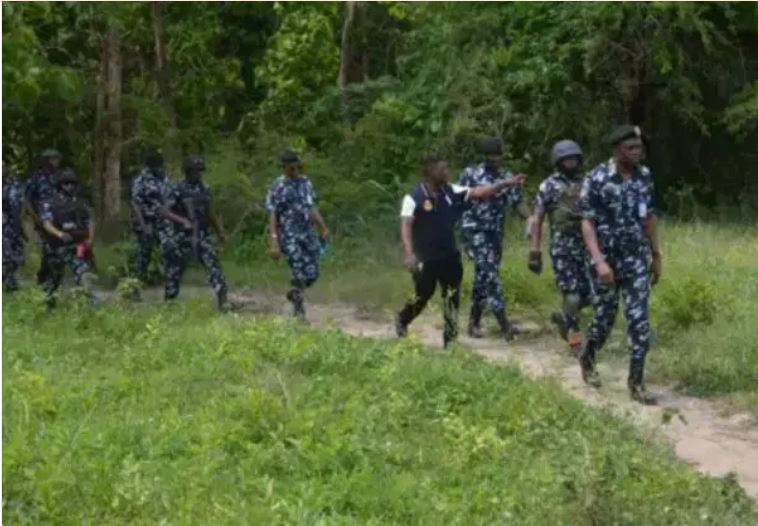
Fifty days have passed since the silencing horror began. Not the ordinary silence of rural dusk settling over farms and footpaths, but a deeper, more oppressive silence – the kind that followed gunfire into a community. It has not left since then.
In Esiele, Yawota, and Ahoro-Esinele, silence now has texture. It sits on doorsteps, lingers in empty classrooms, and hangs over households where parents still wait for children who left for school and never returned.
On May 15, 2026, 42 pupils and education workers from Baptist Nursery and Primary School, Yawota; L.A. Primary School; and Community Grammar School, Esiele were abducted and taken into the vast wilderness of the Old Oyo National Park.
Fifty days later, they remain unaccounted for, trapped in a conflict that has stretched beyond the forests of Oyo State into the depth of national anxiety.
What began as a local tragedy has evolved into a complex national security crisis, raising uncomfortable questions about Nigeria’s evolving threat landscape, the vulnerability of rural education systems, and the growing audacity of insurgent networks once believed to be geographically contained.
A nation’s shock, a community’s rupture
The initial shock of the abduction rippled across the country. It was not merely the scale of the kidnapping that stunned observers, but its location. The South-West, long considered insulated from the insurgent violence associated with Nigeria’s North-East, North-West and North-Central, suddenly found itself drawn into the orbit of terror.
Intelligence sources later identified the perpetrators as members of Boko Haram, operating within a forest cell believed to have exploited the dense corridors of the Old Oyo National Park as cover.
For security analysts, the implications were immediate and unsettling. The attack suggested a geographical fluidity in insurgent operations that had previously been underestimated. One retired counter-insurgency expert described it as “a quiet but profound shift in Nigeria’s security map. The idea that extremist groups are fixed to one region is no longer sustainable,” he said. “They adapt, they migrate, and they exploit ungoverned spaces wherever they exist.”
Setting out for Orire
Before dawn broke on Saturday, 27 June, I left Ibadan determined to reach Oriire Local Government before the state government’s curfew took full effect.
The five-hour journey unfolded through lonely highways and isolated settlements, each mile heightening the sense of uncertainty that had gripped the area after the abduction of schoolchildren.
As our bus approached the outskirts of Oriire, uneasy silence replaced casual conversations. Soldiers occupied strategic positions along the roads, yet their presence offered little reassurance.
Reports that the kidnappers had disguised themselves in military uniforms blurred the line between protector and predator, leaving travellers wary of every uniform in sight.
The military had also drawn clear demarcation lines, warning visitors against venturing beyond designated areas.
Several routes had been completely barricaded, while soldiers repeatedly cautioned that movement outside the approved corridors could be dangerous because security operations were still ongoing.
Their warnings were delivered with unmistakable urgency, underscoring the fragile security situation.
Jammed communication
Inside the community, mobile phone signals vanished completely, cutting off all communication with the outside world.
The villages bore the scars of fear. Homes stood abandoned, compounds lay eerily silent and many settlements had been virtually deserted as residents fled over reports that land mines had been planted in parts of the area.
The emptiness was unsettling; it was difficult to imagine that only weeks earlier these communities had been bustling with vitality in everyday life.
The few villagers I encountered spoke cautiously, constantly glancing over their shoulders as though fearful that every conversation was being watched.
It was only after presenting my press identity card that they reluctantly agreed to point me in the right direction.
Before granting access to residents, I was instructed to seek the consent of the community’s traditional head, Baale Alhaji Amidu Bakare.
After listening patiently, he assigned a local guide, who ferried me on a motorcycle to the scene of the attack.
The ten-minute ride through narrow, bush-lined tracks was perhaps the most unsettling part of the assignment.
Thick vegetation swallowed the footpaths, while the stillness of the forest seemed to conceal untold dangers.
Every bend heightened my anxiety, knowing that abandoned homes lay behind us and that some parts of the surrounding terrain had already been declared off-limits by the military.
Standing at the site, the tragedy ceased to be another headline. It became a haunting reality etched into the landscape and into the lives of a community struggling to reclaim a sense of safety.
In Oriire, fear was not merely spoken about, it lingered in deserted streets, echoed through empty compounds and travelled with every cautious step taken by those who had chosen, or been forced, to remain.
Pointing in the direction of the terrorists’ escape route, my guide stepped back a bit, as if frightened by the sight. But it was understandable.
However, movement restrictions were ordered, and no one was expected to head in that direction.
Inside the forest: containment without conclusion
Fifty days on, security forces maintained they have succeeded in achieving what they termed “operational containment” within sections of the forest. Intelligence-led deployments, involving multiple security agencies, have reportedly restricted escape routes and narrowed the operational space of the insurgents.
But containment has not translated into resolution.
The Old Oyo National Park, a sprawling ecological reserve covering more than 2,500 square kilometres, has become a battlefield of invisibility. Its dense vegetation, broken terrain, and limited accessibility provide ideal cover for irregular armed groups familiar with its geography.
Troops advancing through the forest face not only natural obstacles but deliberate tactical hazards. Improvised explosive devices have reportedly been planted along suspected routes, forcing slow, methodical movement.
Every advance requires clearance. Every clearance consumes time. And time, in hostage operations, is never neutral.
A senior security source involved in the mission described the terrain as “an enemy that does not retreat. You are dealing with fighters who understand the forest better than satellite maps do. They relocate constantly. They avoid patterns. And they know exactly how to turn the environment into protection.”
Human shields and moral constraints
Perhaps the most difficult element of the operation is not the terrain, but the captives themselves. Security assessments indicated that the abducted pupils and teachers are being moved periodically and deliberately positioned close to armed fighters. The strategy, according to intelligence sources, is to deter direct military action by using the victims as human shields.
Officials estimate that more than 200 fighters may be operating in clusters linked to the detention zones.
This reality has placed extraordinary constraints on military options.
Any aggressive assault risks collateral damage. Any delay prolongs captivity. It is a balance that commanders describe as “agonisingly narrow.”
One military officer familiar with the operation put it bluntly: “The objective is not just to engage the enemy. It is to bring the children home alive. That changes every calculation.”
The presence of hostages has therefore transformed the mission from a conventional counter-insurgency operation into a delicate exercise in restraint, intelligence gathering, and incremental pressure.
Casualties and the cost of pursuit
The operation has not been without sacrifice.
Reports indicated that several security personnel have lost their lives during engagements in and around the forest, including a Nigerian Army lieutenant. Oyo State Governor Seyi Makinde has confirmed that troops involved in the immediate rescue effort have suffered casualties.
For families and communities, these losses underscored the gravity of the operation. What is unfolding is not an abstract security exercise but a live, costly engagement against an entrenched armed cell operating in difficult terrain.
Yet officials insisted that despite the risks, withdrawal is not an option: “This is a long game. And the stakes are measured in human lives on both sides,“ one senior officer said.
The abductors’ demand and the state’s refusal
Investigations have revealed that the kidnappers are reportedly demanding the release of two senior Boko Haram commanders: Mahmud Usman (also known as Abu Bara’a or Abbas Mukhtar) and his deputy, Abubakar Abba.
The demand places the Nigerian state in a familiar but difficult dilemma: whether to negotiate with armed groups or maintain a strict no-concession policy.
Authorities have firmly ruled out any prisoner exchange, maintaining that such a concession would set a dangerous precedent and incentivise future abductions.
A government security adviser summarised the position: “If the state begins exchanging convicted terrorists for civilians, then every school becomes a bargaining chip.” For families, however, such policy arguments offered limited comfort. Their concern is immediate, personal, and urgent: survival and return.
Why the rescue is yet to materialise, fifty days after
Across Nigeria, one question persists with growing urgency: why has the rescue taken so long?
Security experts point to four interlinked factors. First is the terrain. The Old Oyo National Park is vast, dense, and difficult to navigate even under normal conditions. Military operations are slowed by geography itself.
Second is the use of explosives. Improvised devices planted along suspected routes require careful clearance, limiting speed and increasing risk.
Third is mobility. Intelligence suggests that the abductors frequently relocate the captives, sometimes within short intervals, complicating tracking efforts.
Fourth is the presence of human shields, which restricts the use of force and demands precision over aggression.
A former intelligence officer explained: “People imagine rescue as a moment. In reality, it is a sequence of narrowing possibilities until one becomes viable.”
A forest under pressure, a network under strain
Despite the difficulties, intelligence sources suggested that the insurgents are increasingly constrained within sections of the forest. The containment strategy, though slow, is believed to be tightening operational space.
There are also indications that diversionary attacks in other parts of the country may be linked to pressure on the forest cell, potentially aimed at stretching security resources.
If confirmed, this would reflect a broader insurgent strategy: relieve pressure on a trapped unit by forcing redeployment elsewhere.
Such tactics underlined a key reality of modern insurgency; it is rarely localised, even when it appears to be.
The burden of uncertainty in the midst of silence
Throughout the crisis, both federal and state authorities have maintained a restrained communication strategy. Officials argued that operational secrecy is essential to protect the lives of the abducted.
A spokesperson under the condition of anonymity reiterated: “Our priority remains the safe return of the pupils and teachers. Public disclosure is carefully controlled to avoid compromising ongoing operations.”
Yet the absence of detailed public updates has created a parallel crisis of uncertainty. In communities directly affected, rumours often replace verified information. Anxiety fills the gaps left by silence.
Families described the emotional toll as cumulative. Each day without clarity deepens psychological strain. Each unanswered question becomes heavier than the last.
Life in the shadow of the forest
Beyond the military operation, life in surrounding communities has been fundamentally altered.
Roads leading into Esiele and Ahoro-Esinele remain poorly maintained, making access difficult. Motorcycle transport, now the dominant means of movement, has become increasingly expensive, with fares reaching between N12,000 and N15,000 for some routes.
For many households, such costs are prohibitive. Farmers have reduced movement to their fields. Traders travel less frequently. Entire stretches of rural life have slowed.
Communication networks remain unreliable in some areas, deepening the sense of isolation. In moments of crisis, connectivity is not merely inconvenient, it is critical. Its absence compounds fear.
Education has been among the hardest-hit sectors. Schools remain closed or partially inactive. Chalkboards still bear the last recorded date of attendance: May 15, 2026. Books and desks remain untouched, as though waiting for a return that has not yet come.
The human cost of waiting
In Ahoro-Esinele, waiting has become a form of existence. Among the abducted are very young children, some barely old enough to articulate full sentences.
Psychologists warned that prolonged captivity, particularly for minors, carries long-term emotional consequences even after release.
Parents, meanwhile, described a constant negotiation between hope and despair. Hope sustains them. Despair shadows it.
One father, speaking quietly at a community gathering, captured the mood: “We are told to be patient. But patience has become pain.”
A national test of capacity and conscience
Fifty days after the abduction, the operation inside the Old Oyo National Park has become more than a military challenge. It is a test of national capacity, institutional coordination, and public trust.
The containment of the insurgents represents an operational achievement. But containment alone is not resolution. And resolution remains the only outcome that will restore confidence.
Security analysts cautioned against viewing the situation in isolation. The crisis reflects broader structural issues: ungoverned spaces, rural vulnerability, and the evolving adaptability of insurgent networks.
A security expert in Ibadan, Major Rasaki Salawu (rtd) noted: “This is not just about one forest. It is about how security is projected into spaces that have long been neglected.”
The unfinished road
Fifty days on, the road to the Old Oyo National Park remains both literal and symbolic. It is a route of military advancement, but also a passage of national grief and expectation.
Somewhere within the dense expanse of the forest, 42 lives remain held in uncertainty. Their absence has reshaped communities, strained families, and tested the limits of state response.
For now, the operation continues, slowly, cautiously, and under immense pressure. Security forces move through terrain that offers concealment to those they pursue, while families wait in places where every sound carries the possibility of news.
Until the day the children and teachers are brought home, the story remains unfinished. And the forest, vast and unyielding, continues to hold its silence.


