
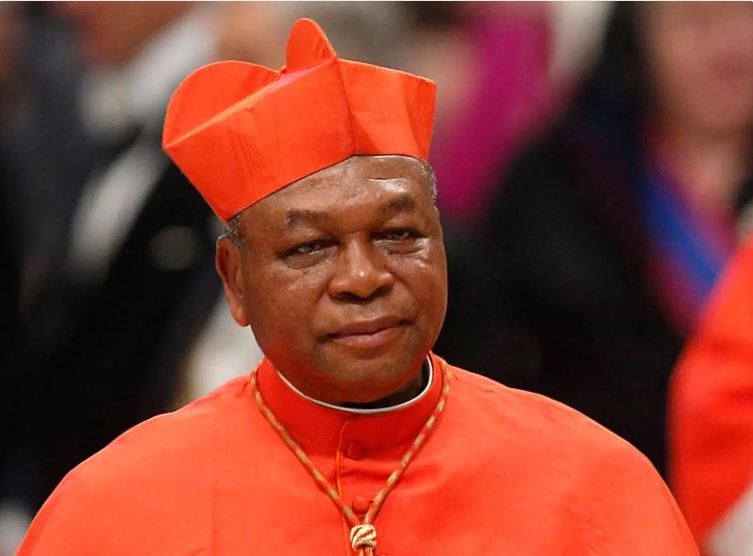
THE judiciary and its increasingly prominent role in determining the outcome of Nigerian elections came under intense scrutiny at the 22nd All Nigeria Editors Conference, ANEC, in Enugu, yesterday, with leading voices warning that democracy was weakened when the courts become the arena in which electoral victories were finally decided.
From the keynote address by Catholic Archbishop Emeritus of Abuja, John Cardinal Onaiyekan, to the interventions of former Nigerian Bar Association President, Mazi Afam Osigwe, SAN, and political economist, Prof. Patrick Utomi, the conference repeatedly returned to one troubling question: Should the courts be deciding who governs Nigerians after voters have supposedly made that decision at the ballot box?
The question acquired particular urgency against the background of the 2027 general elections and concerns over declining public confidence in electoral institutions.
The conference, organised by the Nigerian Guild of Editors, NGE, was held under the theme, “The Ballot, the Media and the Task of Keeping Democracy Alive,” with the sub-theme, “When Lies Look Real: Detecting and Debunking AI Misinformation Before, During, and After Elections.”
Other key personalities, who spoke at the well-attended event included President of NGE and Editor of Vanguard Newspapers, Mr Eze Anaba; Minister of Information, Mohammed Idris; Obi of Onitsha, Igwe Alfred Achebe; and governor of Enugu State, Dr Peter Mbah.
The conference was also attended by Governor Umar Namadi of Jigawa State; Deputy Governor of Enugu State, Ifeanyi Osisi; Vanguard publisher, Uncle Sam Amuka; former governor of Ogun State, Aremo Olusegun Osoba; and Information Minister, who was represented by Ali. M Ali, the MD of NAN,
Others include Prof. Auwal Yadudu, SAN; Chief Onyema Ugochukwu; Tunde Rahman; Prof. Stella Ọkunna, and INEC chairman, Joash Amupitan, who was represented by Enugu REC, Chukwuemeka Chukwu.
Elections being determined in courts, not at polls
Delivering the keynote address, Onaiyekan said democracy was ultimately about government serving the people, adding that elections should provide the mechanism through which people were elected.
He expressed concern that Nigeria’s electoral system had evolved into one in which the courts increasingly became the final battleground for political contests.
According to him, the judiciary was originally intended to adjudicate disputes arising from elections, not to become the institution through which electoral victories were effectively determined.
“The judiciary is supposed to be the last stage in the electoral process. It should be stressed that the judiciary is not to determine elections about who wins, but rather to adjudicate disputes when they arise,” he said.
He argued that if elections were properly conducted, there should be little need for prolonged litigation.
“If elections were well conducted, there ought not to be any need for judicial cases. The tribunals were supposed to be there just in case.”
But, according to him, Nigeria’s recent experience had produced an uncomfortable reversal.
Onaiyekan said: “Our experience in the recent past has almost become that we have been witnessing a situation where our elections are being determined not at the polls, but in the courts by the tribunals.’’
He said the development had created opportunities for highly paid lawyers to exploit technicalities in prolonged legal battles.
“This gives a field day for high-class lawyers with high-level fees, doing their best to manipulate issues on technicalities,” he said.
The Cardinal also expressed concern over allegations of unjust judgments in election tribunals, saying such perceptions had damaged public confidence in one of the country’s most important institutions.
“There are allegations that are difficult to deny of unjust judgments by some judges in election tribunals,” he said, adding that the performance of the judiciary in recent elections had “seriously dented the image of this hallowed institution.”
He said efforts must be made to restore public trust in the courts.
Among others, Onaiyekan, who urged the media to resist pressure and uphold democracy, called for electoral reforms, independent INEC, and for a candidate to score at least 50 per cent of votes cast to be declared winner of a presidential election.
Onaiyekan’s seven-point reform agenda
Onaiyekan proposed a series of reforms aimed at reducing the dependence of Nigeria’s electoral system on post-election litigation.
Among them was the creation of a special election tribunal dedicated exclusively to electoral cases and required to dispose of petitions within a defined period.
While arguing that that election disputes should be resolved before elected officials assumed office, the cleric said: “More seriously, we must do all that is necessary to dispose of all tribunal cases before swearing in any candidate.’’
He questioned the fairness of a system in which a declared winner assumed office and then used the machinery and resources of government to defend the victory in court against an opponent.
“A situation where a candidate has been declared a president still going to tribunal to defend his position using state means and state resources to defend himself against his opponents is not serious as far as natural justice is concerned,” he said.
Onaiyekan further argued that ordinary voters should have a greater role in electoral litigation.
Under the present system, he noted, candidates were generally the principal parties with the legal standing to challenge election results.
But the people who actually cast the votes, he argued, should not be completely excluded from the legal process where they believed their votes were improperly counted.
“We who cast the votes and whose votes are at stake have no room to complain. This must change,” he said.
He also proposed a review of the process for appointing INEC leadership, arguing that electoral commissioners should not be overly dependent on political authorities who might themselves be contestants in elections.
Onaiyekan questioned how genuinely independent the commission could be when its leadership structure was closely connected to the executive arm of government.
The cleric, who urged Nigerians not to abandon the democratic ideal because of its imperfections, acknowledged that democracy was difficult to practise but argued that Nigeria could not use that difficulty as an excuse for accepting defective institutions.
“The ultimate objective is to install a government that is freely chosen by the people and that works for the common good of the people,” he said.
He also stressed the importance of the character of those who emerge as leaders, saying “they must be persons with a minimum of social values and character: honesty, concern for the common good of citizens as priority of governance, absolute respect for the rule of just laws.’’
For the Nigerian media, the challenge ahead, he noted, was therefore larger than reporting an election.
According to him, it is the challenge of protecting the information upon which citizens make electoral choices, scrutinising those who exercise public power, reporting the work of electoral institutions and courts accurately, and ensuring that neither political propaganda nor technological deception was allowed to become a substitute for truth.
He said the 2027 election would ultimately be decided through votes but noted that the credibility of those votes would depend heavily on whether Nigerians could trust the institutions that counted them, the courts that adjudicated disputes over them, and the media that told the public what happened.
Osigwe speaks
Onaiyekan’s concern was amplified by the immediate past president of NBA, Osigwe, who told editors that Nigeria had become one of the countries with a high number of election petitions.
Speaking on “Election Petition in the Digital Age: Independence, Evidence, BVAS,” the former NBA president said the increasing involvement of the courts in electoral contests had raised fundamental questions about whether elections were being determined by voters or through litigation.
“I see that Nigeria is one of the countries with the highest number of election petitions, and all because the courts are very frequently involved in determining either the outcome or who won,” Osigwe said.
He recalled that a judge had previously described the development as the “judicialisation of the electoral process.”
For Osigwe, the expression captures a growing problem in which electoral disputes move from polling units to courtrooms, transforming judges into key actors in determining the political fate of candidates.
“All too often, the courts are merely called in to give direction on issues of procedure,” he said.
He identified the difficulty of proving electoral violations as one factor driving litigation, arguing that the way elections were conducted and the limited time available for petitioners to establish their cases had made the judicial process even more complicated.
He also questioned aspects of the evidential framework governing election petitions, particularly where technology, such as the Bimodal Voter Accreditation System, BVAS, and the INEC Result Viewing Portal, IReV, was involved.
He argued that technological systems introduced to improve electoral transparency should not become additional obstacles for candidates seeking to establish alleged irregularities.
Technology, he maintained, should make elections more transparent rather than make it harder for petitioners to prove what happened at polling units.
He also questioned the treatment of subpoenaed evidence in election petitions, particularly documents which petitioners might not have been able to obtain before filing their cases.
On IReV, Osigwe argued that the platform should receive meaningful evidential recognition in election litigation, even if it was not treated as the primary evidence of election results.
His concerns extended to proposed legal provisions which, according to him, can prevent non-compliance with INEC regulations and guidelines from constituting grounds for challenging an election.
He argued that where INEC was empowered to make regulations and guidelines, compliance with such rules should have consequences for the credibility of the electoral process.
The central issue, he said, was whether a person should be declared the winner of an election when questions remained about whether the process leading to that declaration complied with the rules.
‘Go to court’ culture
Osigwe also took aim at the familiar political expression, “Go to court,” which is often directed at defeated candidates after disputed elections.
He questioned what such statements communicated about confidence in the electoral justice system.
For him, the phrase can create the impression that political actors already understood the limitations confronting those who seek judicial redress.
The former NBA president also raised concerns about public perceptions of corruption within the judiciary, while making clear that he was not personally vouching for allegations of bribery against judges.
He said the widespread perception that litigants might have to pay for favourable judicial outcomes was itself damaging to confidence in the justice system.
The issue, according to him, is particularly sensitive because the judiciary represents the final institutional avenue for candidates and citizens who believe that an election has been conducted improperly.
He noted that if citizens lose confidence in that avenue, the consequences extend beyond individual election petitions to the legitimacy of the democratic process itself.
Osigwe similarly raised questions about public confidence in the electoral commission, particularly the process through which its officials were appointed.
‘’The concern is not merely institutional. Where the electoral umpire is perceived as lacking independence, the credibility of election results can be affected even before disputes reach the courts.
That, in turn, increases the likelihood of litigation and places additional pressure on the judiciary,’’ Osigwe added.
The ballot versus the courtroom
On his part, President of the Nigerian Guild of Editors, Eze Anaba, captured the relationship between the ballot and the judiciary when he said the credibility of elections must be protected, so courts would not have to replace citizens in determining who represented them.
“The credibility of the ballot must be protected so that the courts do not have to replace the citizenry in determining who should represent the people,” Anaba said.
He said voters could only make informed choices when they had access to credible information and were free from intimidation and undue influence.
For Anaba, therefore, the media’s responsibility begins long before election day.
He said editors must provide citizens with information that allowed them to assess candidates, policies and government performance without being manipulated by political propaganda or misinformation.
AI opens another battlefield – Idris
But as Nigeria approaches another election cycle, the traditional problems of electoral politics are being compounded by a new technological threat: artificial intelligence.
The Minister of Information and National Orientation, Mohammed Idris, who was represented at the conference by the Managing Director of the News Agency of Nigeria, Ali M. Ali, warned that AI-generated misinformation could create an entirely new environment in which fabricated events appeared real.
He said artificial intelligence had made it possible to create convincing photographs, videos, audio recordings and documents that had never existed.
“A false statement can be produced in the voice of a public official. A fabricated video can be circulated within minutes. An old photograph can be presented as a current event,” Idris said.
The danger, he warned, was not only that people might believe falsehoods, but that they could eventually lose confidence in everything they saw or heard.
The minister urged editors to make verification a permanent newsroom culture.
He challenged journalists to ask basic questions, including who said it? What is the evidence? When was the photograph taken? Is the video original? Has the source been independently verified? Does the headline reflect the story? Before publication.
He also urged journalists to distinguish clearly between fact, allegation and opinion.
“The job of a professional journalist is not to amplify every claim simply because it is politically attractive. The job is to establish what is true, provide context and allow citizens to make their own judgments,” he said.
Achebe: ‘When the mirror is cracked’
Chairman of the conference and Obi of Onitsha, HRH Igwe Alfred Nnaemeka Achebe, warned that AI-generated misinformation could distort the very information upon which citizens based electoral decisions.
He said a voice could be fabricated to sound exactly like a governor, while a video could place a political candidate at an event that never happened.
“A voice that sounds exactly like a governor can now say what he never said. A video can place a candidate where he never was,” Achebe said.
He expressed particular concern about the speed with which false information could travel through WhatsApp groups, family networks, town unions and community platforms.
Achebe, who urged journalists to place verification above speed, said: “The discipline of pausing to ask, ‘how do I know that this is true?’ must become as instinctive as the instinct to rush to publish used to be.’’
He proposed the creation of a joint Election Rapid Response Desk involving newsrooms that could identify, verify and debunk viral falsehoods before they spread widely.
Using a striking metaphor, Achebe described the ballot as the citizen’s voice and the media as the mirror through which the citizen sees the world.
“When the mirror is cracked, or worse, deliberately distorted, the citizen no longer votes from truth, but votes from illusion,” he said.
Utomi’s warning
For Utomi, the consequences of a failing electoral system go beyond elections.
He warned that weak institutions could ultimately undermine the stability and survival of the country.
The political economist said elections were essential to legitimising government and building institutions.
“If the people are convinced that there is no point, what is an election? Imagine the amount of money we waste to have elections that are totally meaningless because they do not legitimise anybody,” he said.
Utomi argued that strong institutions create predictable rules and reduce uncertainty.
But when abnormal practices became normalised, he said, the cost of doing business rises and citizens gradually lose faith in legitimate avenues for resolving grievances.
“What has happened to us, unfortunately, is because the abnormal has become so accepted that the transaction costs of engaging in Nigeria are such that we are only heading in one direction — ultimate collapse,” he warned.
He said the media had a critical responsibility in preventing such institutional decay.
Press, govt must meet at point of truth – Mbah
In his remarks, Enugu State governor, Peter Mbah, challenged Nigerian journalists to deepen investigative journalism and relentlessly establish facts in the face of growing artificial intelligence-generated misinformation capable of making falsehoods appear real.
He said the press and government might have different responsibilities but must ultimately serve the same purpose — the interest of the Nigerian people.
The governor, who joked that the gathering offered a temporary “ceasefire” between government and the media, said: “Government must be transparent about what it is doing and be accountable for the results. The press must establish the facts and report the truth.”
He urged journalists not to allow investigative journalism become a lost art, stressing that newsrooms must be willing to distinguish between information that merely generated attention and issues the public genuinely needed to know.
According to him, “rigorous journalism is not about finding evidence to support a position already taken, nor should it become another arena for political grandstanding.”
Mbah also used the occasion to highlight his administration’s development programmes, saying his government was seeking to transform Enugu into an economic gateway for the South-East, one of Nigeria’s top three states by GDP and a national leader in human development and quality of life.
He listed more than 1,500 kilometres of roads constructed or reconstructed, over 7,000 classrooms delivered, Smart Green Schools and Type-2 primary healthcare centres across the 260 electoral wards, restoration of water supply in Enugu metropolis, new transport terminals, CNG buses and the revival of dormant industries.
He also cited the operations of Enugu Air and the development of Enugu Smart City as part of the transformation agenda.
The governor said the state had enjoyed strong collaboration with President Bola Tinubu and the federal government, particularly through increased support to states and interventions in roads, aviation, energy and regional development.
He said the concessioning of Akanu Ibiam International Airport would further strengthen Enugu’s position as a gateway to the South-East.
Mbah, however, acknowledged that there was still much work to be done, urging the visiting editors to move beyond official claims and independently assess the changes taking place across the state.


