Uche Amunike
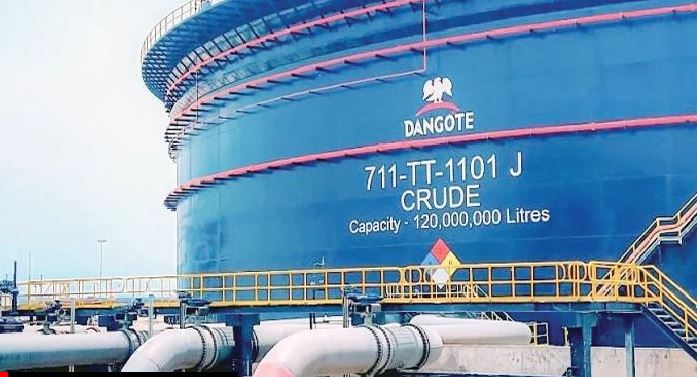
The Dangote Refinery decision to price petrol, diesel and aviation fuel in United States dollars has raised fresh concerns across Nigeria’s downstream petroleum sector, as fuel prices jumped by about N100 per litre at some depots.
Petroleum marketers may now require an estimated $1.84 billion monthly to purchase refined products from the refinery, putting additional pressure on Nigeria’s foreign exchange market and exposing consumers to more frequent fuel price changes.
The development follows a notice from Dangote Petroleum Refinery announcing that payments for all gantry product lifting would move from naira to dollars, effective July 13. Previously issued naira invoices were subsequently cancelled, with marketers expected to comply with the new dollar payment arrangement.
Under the revised pricing structure, Premium Motor Spirit (PMS) is quoted at $0.779 per litre, Automotive Gas Oil (AGO), commonly known as diesel, at $1.087 per litre, while Aviation Turbine Kerosene (ATK) is priced at $0.942 per litre. The change does not apply to Liquefied Petroleum Gas transactions.
Based on current consumption and supply estimates, marketers could require about $60.7 million daily to buy products from the Dangote Refinery. Petrol alone accounts for approximately $36.9 million daily, or about $1.1 billion every month.
Diesel purchases could require another $20.4 million daily, translating to roughly $633.5 million monthly, while aviation fuel may account for about $3.4 million daily or $105.1 million per month.
The effect is already being felt in the market. PMS depot prices reportedly increased from N1,137 to as high as N1,250 per litre in some locations, representing an increase of N113. Some petroleum depots also raised their loading prices from between N1,090 and N1,120 per litre.
Diesel prices equally escalated, with ex-depot rates reaching as high as N1,650 per litre, an increase of up to N150 in some depots.
The price increases come days after the Federal Government called for lower petrol prices. They also coincide with a rise in global crude oil prices to about $85 per barrel.
According to Industry analysts, the Dangote Refinery dollar pricing policy could transfer foreign exchange risks to marketers, who earn revenue in naira but must now source dollars to purchase petroleum products.
Energy economist and founder of Energy Business Analytics, Dr Kaase Gbako, said the decision could indicate growing pressure on the Federal Government’s naira-for-crude arrangement or increased dependence on imported crude oil.
According to him, the refinery has effectively transferred FX risks from crude suppliers to downstream operators and, ultimately, Nigerian consumers. Marketers may also include the cost of sourcing dollars and possible delays in their pricing, further increasing pump prices.
Professor Emeritus of Petroleum Economics, Prof. Wumi Iledare, said the development reflects the realities of a deregulated petroleum market, where crude oil is internationally traded. However, he warned that marketers would require stronger foreign exchange procurement and treasury management strategies.
Former President of the Nigerian Economic Society, Prof. Adeola Adenikinju, also warned that increased dollar demand could put further pressure on the naira. He noted that domestic fuel purchases may increasingly resemble import transactions, despite the products being refined locally.
Petroleum marketers have expressed concerns that the policy could gradually dollarise Nigeria’s downstream sector. The Petroleum Products Retail Outlets Owners Association of Nigeria and the Independent Petroleum Marketers Association of Nigeria questioned how marketers would source dollars for products sold entirely in naira.
Analysts said the impact on consumers would largely depend on the stability of the naira and international crude oil prices.
The latest Dangote Refinery pricing decision has also renewed questions over the effectiveness of the naira-for-crude initiative introduced in October 2024 to reduce foreign exchange pressure, encourage domestic refining and strengthen Nigeria’s energy security.