
Taiwo Aliyu is finally ready to wear the new clothes he sewed for the Eid al-Adha celebration in May. Fifteen days before the festival, gunmen stormed First Baptist Nursery and Primary School, Yawota, abducting his two children, Shuaib and Wasilat, alongside dozens of other pupils and teachers from nearby schools in Oriire LGA of Oyo state.
A total of 39 pupils and seven teachers were kidnapped from First Baptist Nursery and Primary School, L.A. Primary School, Yawota, and Community High School, Esin Ele. Michael Oyedokun, a teacher, was killed by the kidnappers on the second day of captivity.
For 56 days, Aliyu lived in limbo. Four children were taken from his family, including his nephew and cousin.
“The only thing I could digest was water. The food just wouldn’t go down my throat,” the farmer told TheCable.
“I didn’t go home for Sallah. There was nothing to celebrate.”
That changed on Friday when the federal government announced that all the abductees had been rescued following a joint security operation.

“Now that my children are back, I will wear the Sallah clothes and celebrate,” he said.
“I slept so much yesterday. I had the best sleep of my life.”
WILL ORIIRE’S CHILDREN RETURN TO SCHOOL?
In the days after the attack, the Oyo State Universal Basic Education Board (OYOSUBEB) shut schools across Oriire and nearby LGAs as fear spread. Hundreds of children who were never kidnapped also stopped going to school, while the Nigeria Union of Teachers (NUT) embarked on an industrial action that further disrupted learning across the state.
Now, parents must decide whether to return their children to the same classrooms where they were whisked away. For Aliyu, the answer depends on what happens next.
Before the attack, he rode his motorcycle every morning from neighbouring Oniya community to Yawota, taking not only his own children but six others to school.

“I have two children, but I used to take eight pupils to school on a bike from Oniya. Because when they’re late, they get punished,” he said.
Aliyu said whether his children will return to school in the community depends on whether the government provides improved security and social services for them. The kidnapping has not changed his belief in education — what has changed is his demand for protection.
“If the government helps us, we will bring them back. There is no need to take the children to town, or anywhere else, if we see security and competent teachers. We want this school to progress, to develop,” he said.
“But if not, I will take them straight to Lagos.”
His dilemma reflects the mood across the farming community. Most parents do not want to abandon their homes or uproot their children. They want assurances that sending them to school will not become another gamble with their lives.
A SCHOOL WAITING FOR ITS PUPILS
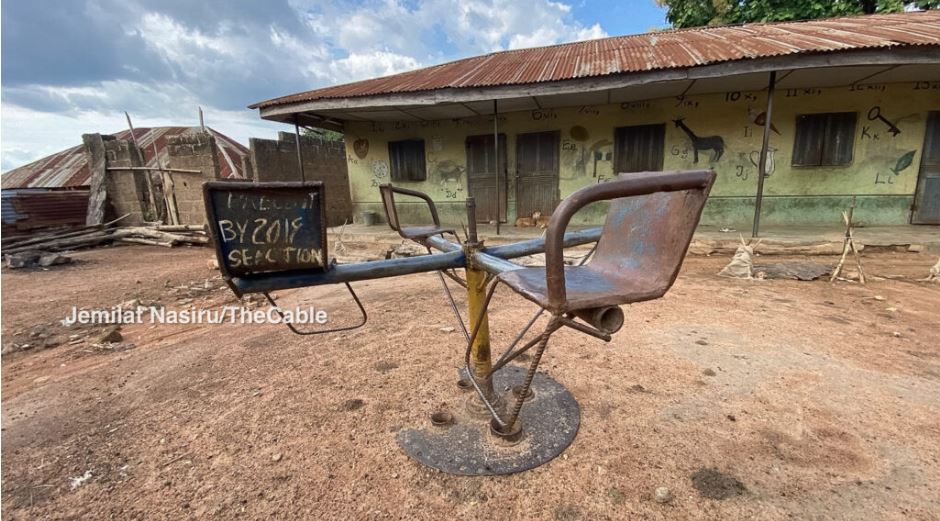
Sunday Oyekola unlocked the classrooms at First Baptist Nursery and Primary School for the first time since the attack to find them covered in a buildup of cobwebs. The scene is evidence of the chaos that disrupted the lives of his students and teachers.
Oyekola has been managing the school, which has classes from kindergarten to primary 5, since 2008.
The proprietor said an estimated 150 students are enrolled in the learning facility.

He added the reopening of the school depends on whether parents feel confident enough to send their children back.
“Our salvation is in the hands of God, but we believe government will do something so that security will improve,” Oyekola said.
“When security is better, people will come back. We know that it will shake the school, but we will have restoration.
“The time to reopen the school is in the hands of the parents. If the parents cooperate with us, we can make some plans for security operatives, like Amotekun or local hunters, to secure the school. We need electricity, internet connection and other social amenities. For now, we use a generator.
“We have a polling unit here, and we vote, but we still don’t have these things. Let the government help us.”
DIFFERENT FAMILIES, DIFFERENT CONCLUSIONS
Despite the trauma, many parents insist their children will return to school. Damilola Sunday, the mother of an abducted pupil, said her children would return to school once adequate security is provided.
“We’re not saying our children won’t go back to school. My child is very young. I don’t have any task to give such a child. They have to go to school,” Sunday said.
Since the attack, she has not returned to her farm out of fear. However, Sunday said she has no plans to leave the community.
“I have never left before,” she said.

Other parents have, however, reached a different conclusion. Sarah Ojo said seeing her granddaughter alive ended weeks of anxiety, but the experience convinced her that the children should leave Yawota.
“Business is good here. I will remain here, but the children will go to town,” Ojo said.
Also, Maria Balogun, who brought two children from Cotonou to Nigeria, is also preparing to return with them to the Benin Republic, where she said relatives have been waiting anxiously.
“When I see my child, even with the pain I’m feeling in my back, I’ll carry her, slaughter a big chicken, cook vegetables and make soft semo for her,” she said.
“But I will take them home for now; my people want to see them. We will later decide on what to do next.”
THE TRAUMA TEACHERS CARRY

The uncertainty is not limited to parents. When schools eventually reopen, teachers will also have to decide whether they are ready to return to the classrooms where the attack unfolded.
For 36-year-old Olabisi Oladokun, that decision carries memories she has not been able to shake off. She had been teaching at First Baptist Nursery and Primary School for barely two weeks when gunmen attacked.
Forced into the forest alongside pupils and colleagues, she seized a rare chance to escape after the motorcycle transporting her lost its balance and fell.

“My thigh still hurts from the jump,” Oladokun said.
“I have not been okay; I’m afraid.”
But her husband, Kehinde, a pastor in Oniya, said if they see improved security, his wife will return to the classroom.

“I will even be the one driving her there,” he said.
WHAT NEXT?

The rescue of the abducted children has restored hope to Oriire, but it has not erased the questions of whether schools remain a safe space for their children. The attack, the first mass school abduction recorded in south-west Nigeria, exposed how a single act of violence can disrupt education far beyond those directly affected.
Many parents say they are ready to send their children back to school. Their hope, however, rests on a promise they say only the government can fulfil: that the next time they wave goodbye at the school gate, their children will return home safely.