
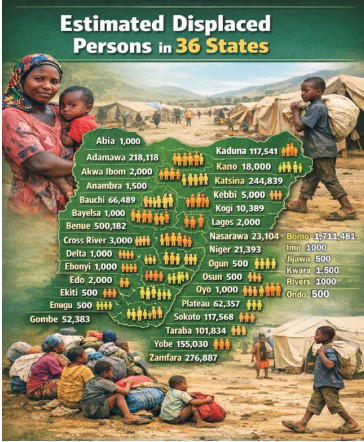
Nigeria is paying a heavy price for years of protracted insecurity, with 3,725,593 internally displaced persons, IDPs, now scattered across about 3,900 camps and settlements nationwide.
Data compiled from the International Organisation for Migration Displacement Tracking Matrix, the National Bureau of Statistics, and humanitarian agencies and government officials showed that the figure is only an estimate, as displacement patterns change frequently.
The crisis has largely been driven by insurgency in the North-East, banditry in the North-West, farmer–herder conflicts in the North-Central, and communal clashes in parts of the South.
Nigeria’s 3.726 million displaced population is larger than the population of at least 63 countries whose populations are under 3.7 million, according to United Nations population estimates.
Among countries with fewer than 3.7 million people are Uruguay (3.4m), Jamaica (2.8m), Qatar (2.7m), Namibia (2.6m) and Botswana (2.6m).
War-time relics flood state capitals in peace time
Across several northern states, the construction and maintenance of IDP camps have become a permanent feature, resembling conditions usually associated with wartime.
Although Nigeria operates a democratic system, many communities face realities akin to conflict zones, as persistent attacks continue to uproot families and destroy livelihoods.
Entire communities have been forced out of their ancestral homes due to repeated attacks by terrorists, bandits, killer herdsmen, cattle rustlers and kidnappers, who invade villages, destroy farms and abduct residents.
The result is the emergence of hundreds of displacement camps and thousands of homeless citizens who were forced out of their homes through no fault of theirs.
Borno runs 2 camps, Yobe has none
In the early years of the Boko Haram insurgency, Borno and Yobe states had the largest number of IDP camps.
However, the number has significantly declined, following resettlement programmes by the two state governments.
Borno, the epicentre of the insurgency, under Governor Babagana Zulum, systematically shut down many camps and resettled residents in their communities.
Currently, only the Madinnatu camp in Jere Local Government Area remains functional.
However, a recent attack in Ngoshe community in Gwoza LGA forced the authorities to open a temporary camp near Pulka to accommodate thousands of displaced residents.
More than 3,000 residents fled Ngoshe, while over 300 civilians, mostly women and children, were abducted during the attack.
Addressing displaced persons during a visit to the Pulka camp, Governor Zulum said: “We are here to commiserate with the people of Ngoshe who lost their loved ones, following the unfortunate incident that occurred last Tuesday. The situation is very sad and our hearts go out to all those affected by this tragedy.
“I want to assure you that we will do everything possible to address the unfortunate situation that has befallen this community.
“For now, we will distribute food items to those affected and I have directed that cooking points be established so that everyone in this community can receive meals from a central kitchen.”
Meanwhile, in Yobe State, under Governor Mai Mala Buni, all officially designated camps have been closed after displaced residents were resettled in their communities.
Zamfara hosts 276,887 IDPs in 9 camps
In Zamfara State, more than 276,000 residents have been displaced by persistent bandit attacks.
Reports indicate that at least 107 villages were overrun by bandits between 2009 and 2026, forcing thousands to flee to Gusau, the state capital.
Data from the Zamfara State Ministry of Humanitarian and Disaster Management showed that 276,887 IDPs were recorded as of March 2026.
Of this number, about 75 per cent have experienced multiple displacement, while only 18 per cent live in formal camps.
Major camps include Tsunami, Mareri, Lalan, Premier, Tudun Wada, Unguwar Gwaza and Anka camps, alongside 46 host community locations.
According to Malam Sani Aminu, an official in charge of food supplies at the Tsunami camp, the state government provides food items such as maize, millet and sorghum.
The Commissioner for Humanitarian Affairs, Salisu Musa Tsafe, said the number had reduced by about 89,000 as security improved, allowing some residents to return home.
Benue home to over 500,000 IDPs
According to the International Organization for Migration, Benue State hosts over 500,000 internally displaced persons, making it one of the worst-hit states.
The state currently operates 14 officially recognised camps.
The Commissioner for Humanitarian Affairs, Mr. Aondowase Kunde, said the government of Governor Hyacinth Alia was shifting from emergency relief to a long-term solution.
“The government is transitioning from temporary relief to a durable solutions framework, focussing on voluntary return, resettlement and reintegration.”
Authorities have begun building 60 permanent two-bedroom houses in Yelewata community, with plans to construct 5,700 homes for displaced residents.
Additionally, 600 hectares of farmland have been allocated to IDP farming cooperatives to promote self-reliance.
90,000 displaced in Taraba camps
In Taraba State, about 90,000 displaced persons are currently sheltered in eight camps located in Peva and Kufai Ahmadu in Chanchanji Ward of Takum LGA.
Many others have crossed into neighbouring communities in Benue State for safety. The crisis prompted a joint visit by Governors Agbu Kefas and Hyacinth Alia to affected communities.
However, investigations revealed that many camps lack basic amenities.
Justin Tyopuusu, Special Adviser to the Governor on Digital Economy, said the government was working to restore security so displaced residents could return home before the rainy season.
Kebbi shuts camps, resettles displaced residents
On its part, Kebbi State government said it currently had no active IDP camps, following successful resettlement of displaced residents, the activities of terror group, Lakurawa, notwithstanding.
Special Adviser on Communications, Abdullahi Idris Zuru, said camps previously located in Kebbi South were closed after security improved.
“We have been able to contain ceaseless attacks on our communities as joint armed forces patrols pushed back the terrorists,” he said.
He added that Governor Nasir Idris provided housing, food, clothing and medical support for the affected communities.
Kwara’s sole camp remains unused
In Kwara State, the only IDP camp established by the federal government in Patigi Local Government Area has never been used.
The North-Central Coordinator of the National Commission for Refugees Migrants and Internally Displaced Persons, Hajia Jumai Ahmed, expressed surprise at the development.
“Yes, there is an IDP camp established by the Federal Government at Patigi, but it has never been put to use,” she said.
Sources said Governor AbdulRahman AbdulRazaq preferred assisting victims directly through relief support and rehabilitation, rather than establishing camps.
Nasarawa hosts 5 camps
The Director-General of Nasarawa State Emergency Management Agency, Dr. Ben Akwash, said the state had five IDP camps, including the major camp at Ugya in Toto LGA.
Other locations include Kadarko and Giza in Keana LGA, Agyragu in Lafia LGA, and Doma in Doma LGA.
He explained that population figures fluctuate, depending on the level of communal clashes.
Thousands displaced in Plateau
In Plateau State, relentless attacks across the state have displaced thousands of residents. Communities in Mangu, Barkin Ladi, Bassa, Riyom, Jos South, Kanam and Wase have suffered repeated attacks.
Unlike other states, most displaced residents in Plateau live with relatives, rather than in formal camps, a system that preserves social ties but strains host families.
Governor Caleb Mutfwang has also launched a task force to facilitate the safe return of displaced residents. The government has also begun a housing project in Ribakwa village in Bassa LGA to resettle affected families.
Adamawa camps run by communities
In Adamawa State, the government closed all official camps as far back as 2014, allowing communities to run their own shelters.
Camps currently operate in Malkohi, Labondo, Bole, Fufore and Sangere Marghi, relying largely on NGOs, religious organisations and philanthropists for support.
Many displaced residents now depend on farming, trade and small businesses for survival.
Sokoto shelters 2,500 displaced residents
In Sokoto State, the government established a major IDP camp at Ramen Kura, within the state capital. The camp currently shelters over 2,500 displaced persons, mostly women and children, who fled terrorists’ attacks.
Officials said the camp was created as an emergency response to a surge in displacement from Gandi, Tureta, Goronyo and Gudu LGAs.
Although authorities provide food, water, healthcare and sanitation services, overcrowding and limited resources remain major challenges.
Estimated displaced persons in 36 states; Abia – 1,000; Adamawa -218,118; Akwa Ibom – 2,000; Anambra -1,500; Bauchi -66,489; Bayelsa -1,000; Benue – 500,182; Borno – 1,711,481; Cross River – 3,000; Delta -1,000; Ebonyi – 1,000; Edo -2,000; Ekiti – 500; Enugu – 500; Gombe – 52,383; and Imo – 1,000.
Others are Jigawa – 500; Kaduna -117,541; Kano -18,000; Katsina – 244,839; Kebbi -5,000; Kogi – 10,389; Kwara -1,500; Lagos -2,000; Nasarawa -23,104; Niger -21,393; Ogun – 500; Ondo – 500; Osun – 500; Oyo – 1,000; Plateau – 62,357; Rivers – 1,000; Sokoto -117,568; Taraba -101,834; Yobe -155,030; and Zamfara -276,887.